Understanding your senses – body & movement

These are often signs that the body’s awareness system, is craving input or trying to find balance.

The body’s internal Vestibular system (located in the inner ear) can cause trouble when it is out of balance as you will experience changes in behaviour, mood and energy. But, when it is working well you feel safe, strong, and organised from the inside out. In this blog, we give you an insight into why you like certain types of movement and how to counteract behaviour with physical strategies.

Proprioception is the automatic sense that tells us where our body is in space and how to move freely without conscious thought. It’s what enables us close our eyes and still touch our nose, grip items with the right amount of pressure, or control the strength of a hug.

We have proprioceptive receptors in our muscles, joints, and tendons which send messages to the brain every time we push, pull, squeeze, stretch, or move our body.

These signals help the nervous system:

  • Know where the body is in relation to space and things around us
  • Control our movement and posture
  • Feel calm, grounded, and secure
  • Regulate our energy levels and emotions

When this system is working well, you will feel grounded, stable, and ready to learn. You’ll be able to move confidently, judge force accurately, and stay more regulated during challenges.

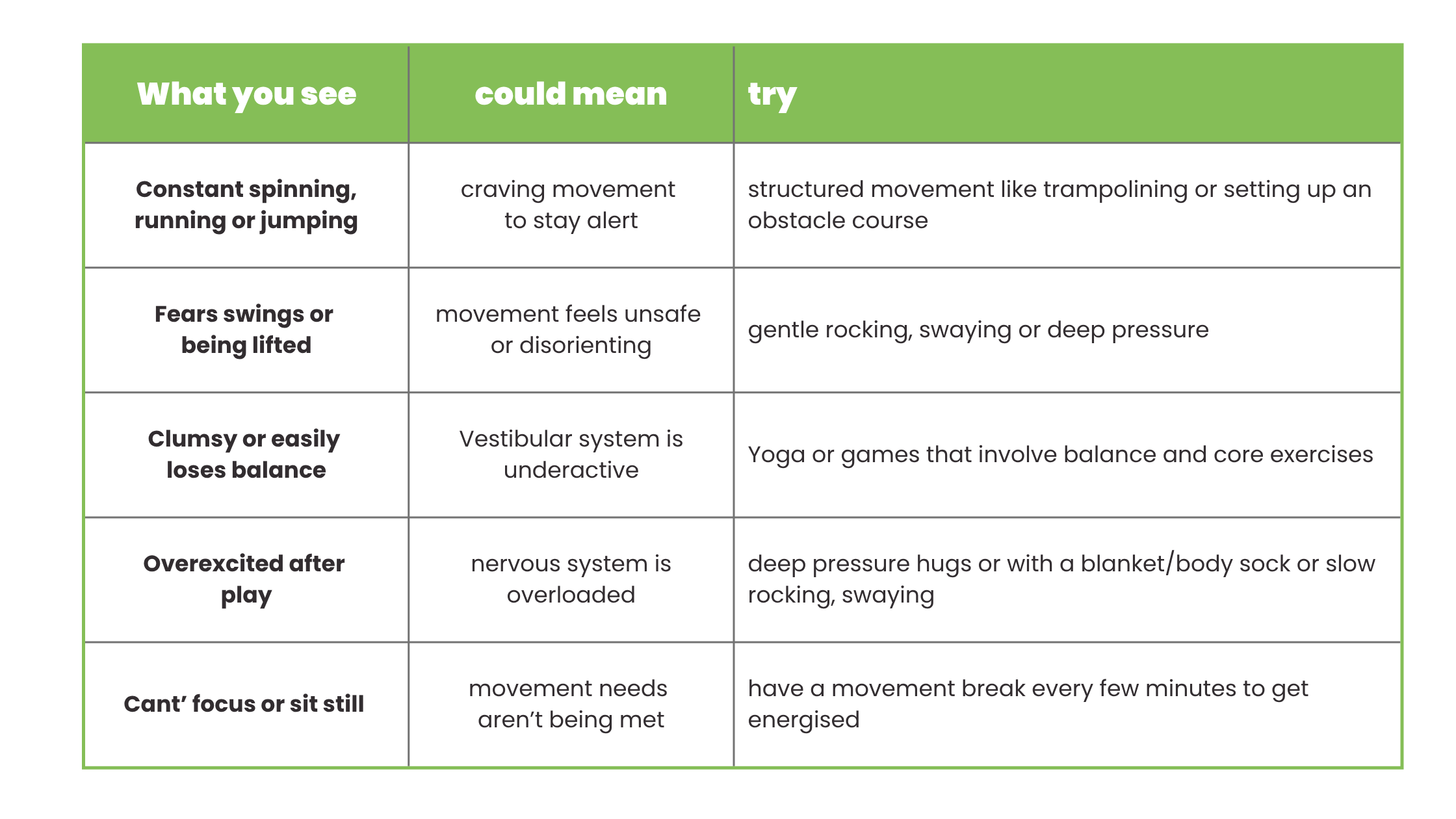
BUT… when it’s not fully balanced, (so is under or over-responsive) you might feel the need for constant movement, often bump into things, or experience clumsiness. In children, you might witness boisterous behaviour or they might completely avoid touch and physical play altogether.

The way you move and interact with others will change depending on lots of different factors, your environment, stress levels, emotions, the people you are with etc.

So it is good to understand the different behaviours and how to counteract them to stay balanced.

You are craving more input to “wake up” the body and you might:

  • Constantly be on the go! Jumping, spinning, running etc.
  • Often bump or crash into people and objects
  • Struggle to sit still or concentrate
  • Use too much force in play, writing or grip
  • Enjoy tight hugs, wrapping up in blankets, or carrying heavy things
  • Seek rough or high energy activities.

Movement helps you wake up and feel alive but it needs to be structured to be controlled and healthy:

  • Schedule ‘movement breaks’ in the day
  • Push/pull or lift/carry heavy items/toys
  • Build dens, move furniture, or dig in the garden
  • Do exercise to activate big muscles (for children that could be a game of moving like animals, bear crawls, frog jumps etc.)
  • Include rhythm by dancing, skipping or marching to satisfy your need for high tempo movement

You are oversensitive to input and easily overwhelmed by sensations or touch. For example:

  • Movement feels too much, or unsafe
  • Feel dizzy or unsettled by sudden movements.
  • Prefer light movement and controlled activities
  • Being hyper aware of tags, seams or zippers on clothes. Tight or ill-fitting clothes can be stressful.
  • Children actively avoid messy play and rough-and-tumble games.

Keep physical movement slow and at the level you are comfortable with so it isn’t overwhelming. You/they must feel in control:

  • Deep pressure – weighted blankets, firm hugs (if welcomed), or rolling a ball over the body
  • Rocking, swaying or gentle walking.
  • Try yoga or relaxation exercises
  • Develop calming routines that include safe, consistent physical touch (maybe bedtime massage or cuddles).

The goal isn’t to stop the movement seeking/avoiding behaviours but to find balance and feel safe in your body.

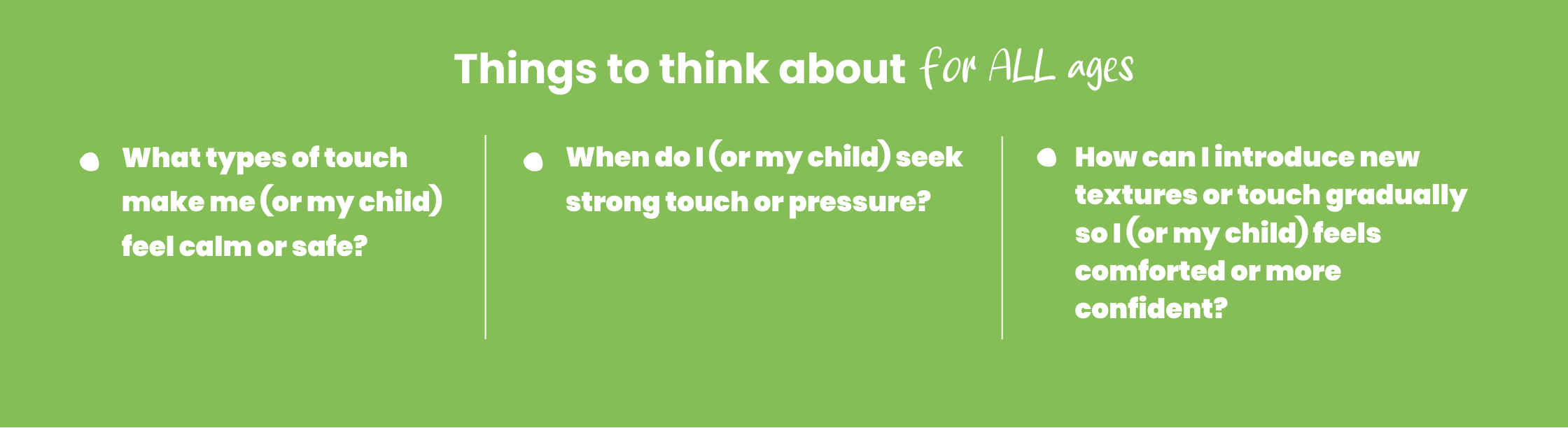
Take some time for reflection on what movement does to you and how you feel with different types of motions. What kind of movement makes you feel calm, happy or safe? Are there any things you like to do when you feel restless or anxious or tired?

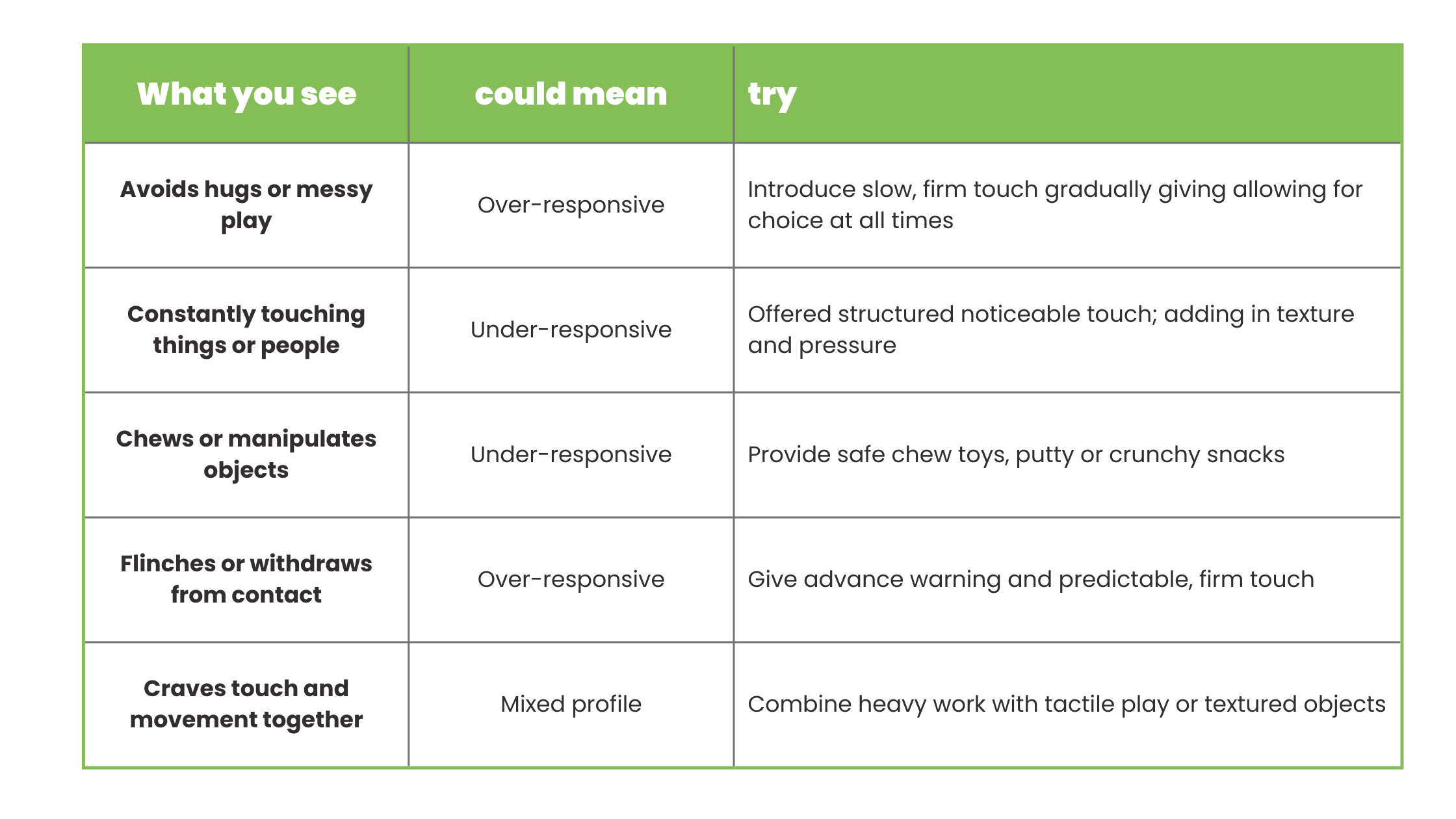
Here are some signs and behaviours to look out for:

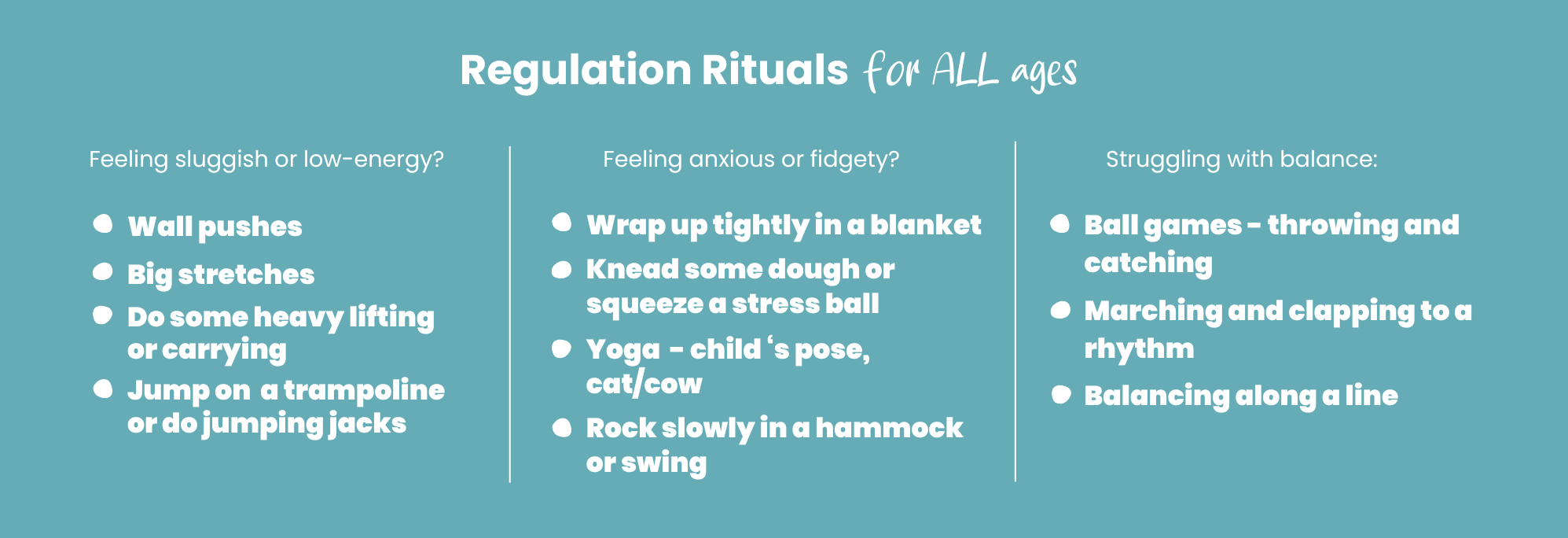
It’s a good idea to incorporate strategies and methods into your daily routine to proactively regulate your body which will make you feel secure and in control. Plus, it will massively improve mood and happiness!

Here are some of our suggestions but remember… everyone is unique:

Keep up to date with the latest SensationALL Self-Regulation Strategies on our socials!

Helping Children Stay Calm

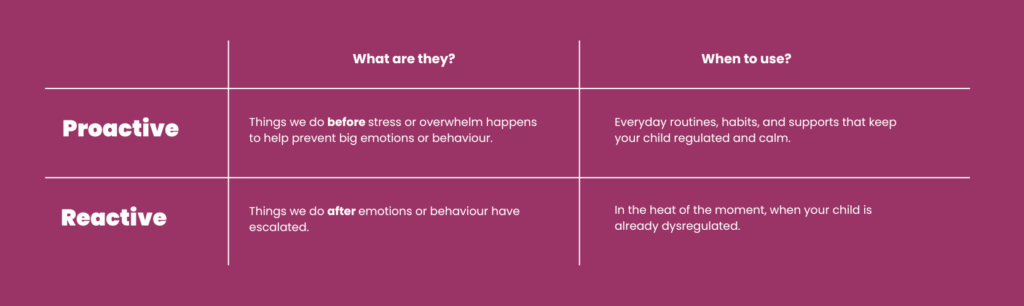
Think of it like weather planning…

  • Proactive is checking the forecast, packing a raincoat, and planning a route to stay dry.
  • Reactive is opening the umbrella when the rain starts.

We need to have both types of strategies because life is calmer when we’re prepared but we can’t plan for every eventuality…

Proactive strategies help reduce stress on the nervous system. They give your child predictability, safety, and skills to manage their emotions before they feel overwhelmed.

Reactive strategies are essential when emotions are already high. They help calm the body and bring your child back to a state where they can think, learn, and connect again.

Using both together builds emotional intelligence, confidence, and self-regulation — key ingredients for thriving in daily life.

  • Proactive strategies engage the “thinking brain” (the prefrontal cortex), teaching planning, reflection, and choice-making.
  • Reactive strategies soothe the “feeling brain” (the amygdala and limbic system) when your child’s nervous system is in fight, flight, or freeze.

When we focus on proactive support, we reduce the frequency of fight or flight moments happening but when they do, they will be less severe or easier to recover from.

These daily habits and routines can help children feel safe, calm, and in control.

1. Sensory-Friendly Environments

  • Reduce noise and visual clutter
  • Dim lights or use warm lamps
  • Offer a calm corner or quiet space
  • Keep routines predictable

Example: A “cosy corner” with soft lighting, fidgets, and weighted blankets gives a child somewhere to retreat before they feel overwhelmed.

2. Self-Regulation Skills

Teach your child what helps them feel calm. This can include:

  • Wall pushes or animal walks (heavy work)
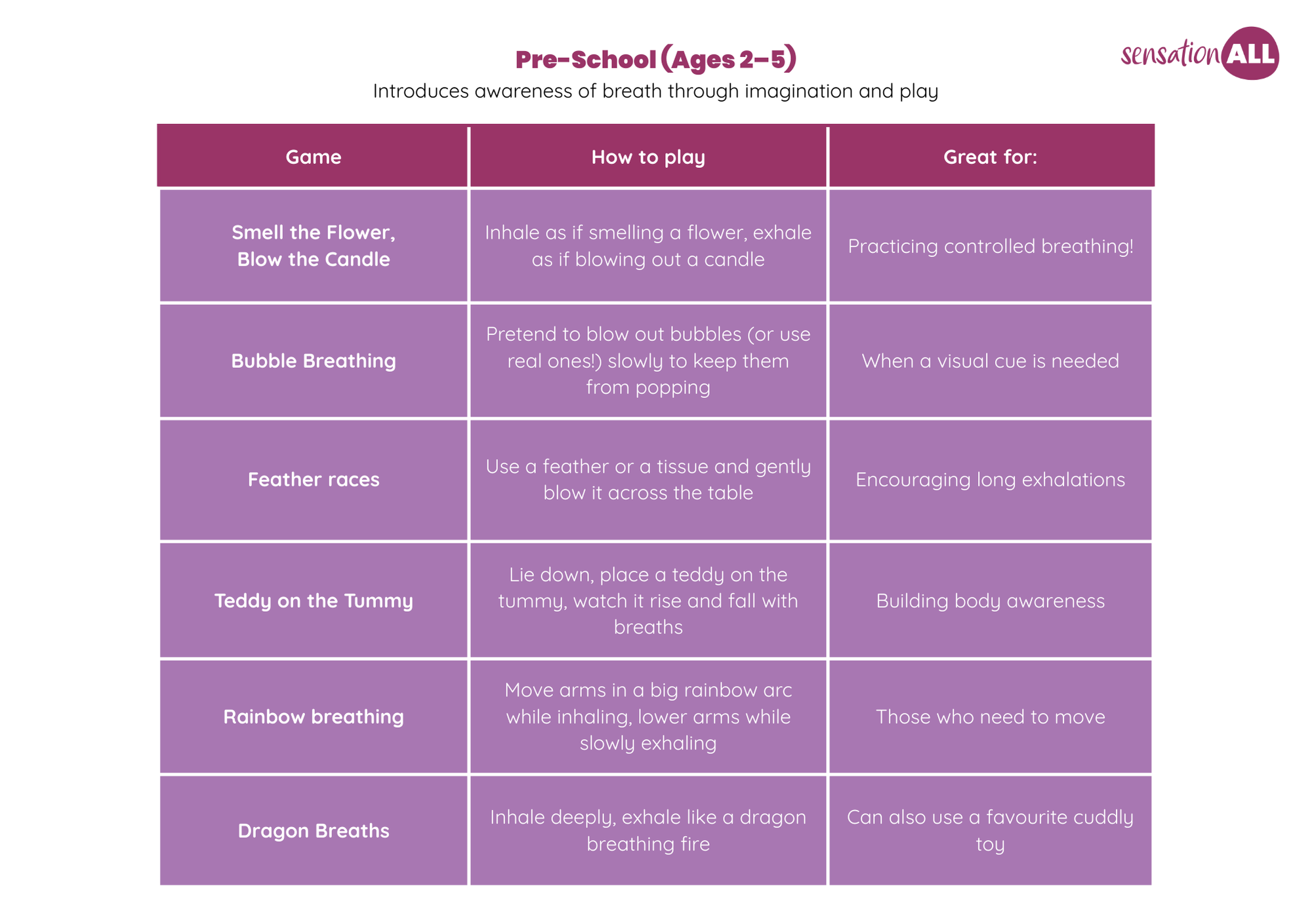
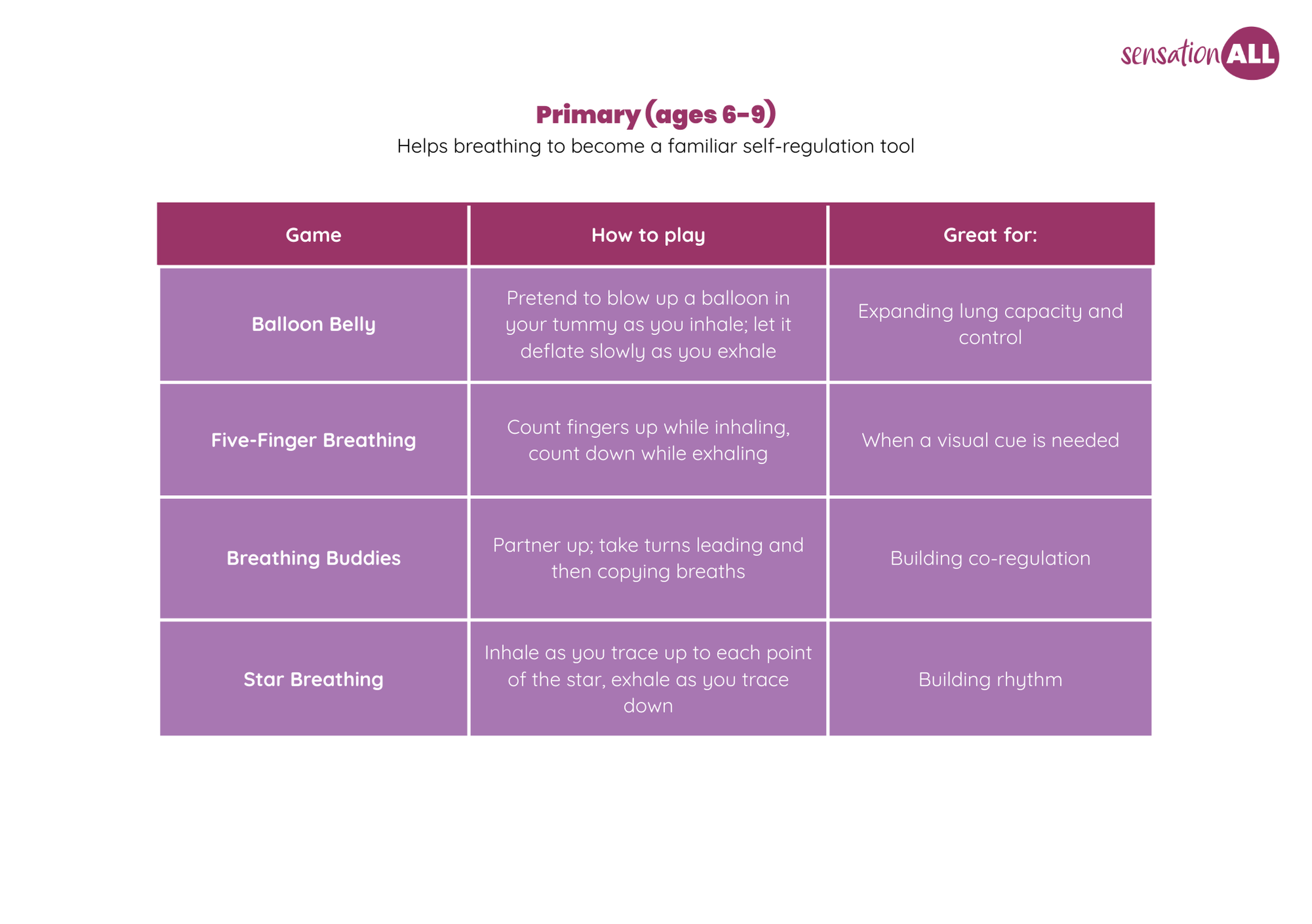
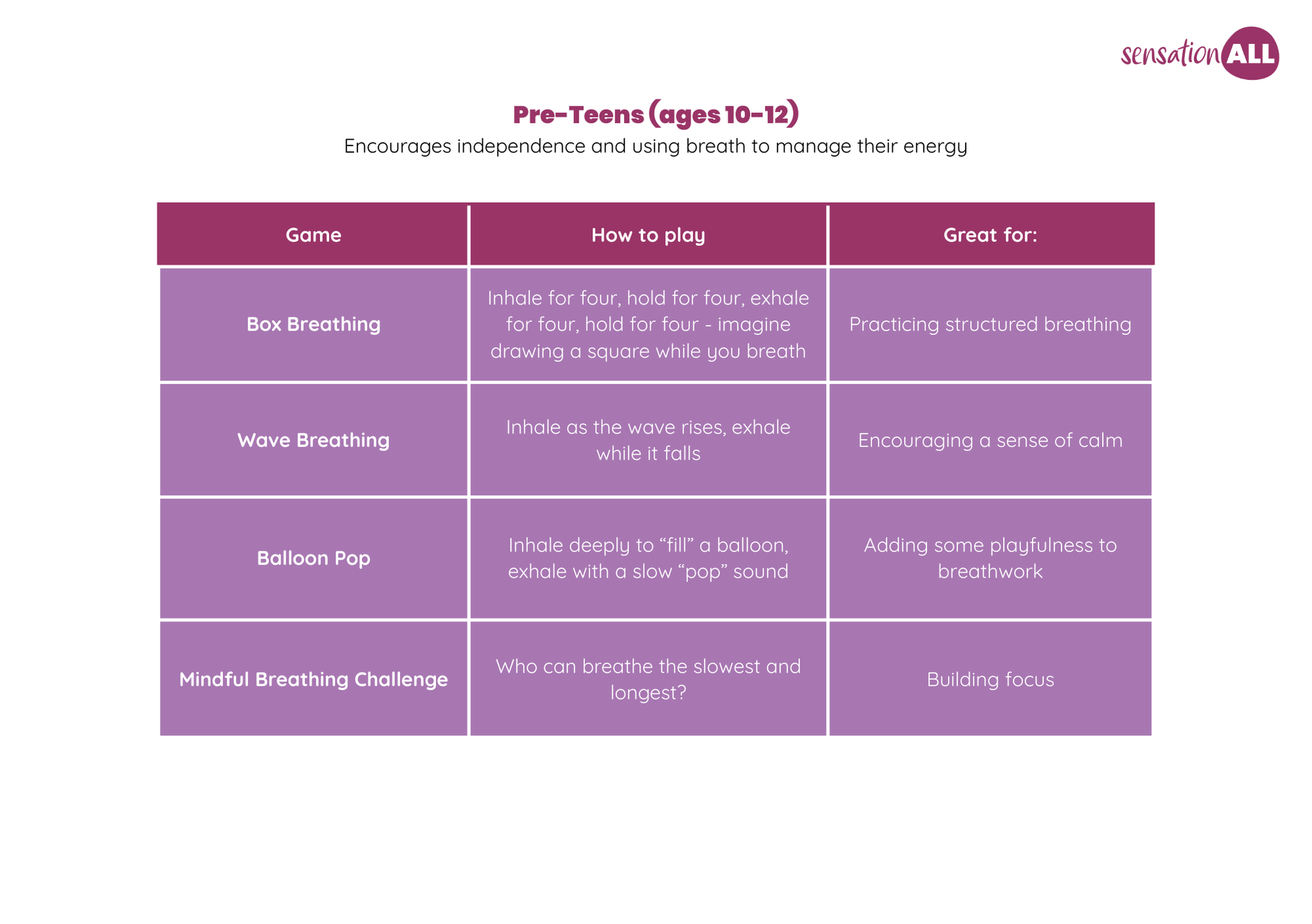
  • Breathing games or blowing bubbles
  • Stretching or yoga poses
  • Crunchy snacks or chewing (oral regulation)
  • Visualization or story-based relaxation

Example: Practice “starfish breathing” together when you’re calm — trace your fingers and breathe in and out with each point.

3. Emotional Education

Help your child name what they feel:

  • Use feelings charts or visuals
  • Talk about emotions in stories or daily life
  • Model naming your own feelings calmly

Example: “I’m feeling a bit frustrated, so I’m going to take a deep breath.” This teaches emotional language and coping by example.

4. Adult Modelling

Children learn regulation from our calm presence.

  • Narrate what you’re doing to calm yourself
  • Use a steady tone
  • Keep routines consistent

Example: “Let’s pause together and take a breath. We can figure this out once we feel calm.”

When your child is already upset or overwhelmed, the goal is calm and connection, not correction.

Try some or all of these:

  • Moving to a quieter, low-stimulation space
  • Using deep pressure (like a firm hug or weighted blanket)
  • Offering a familiar comfort item or soothing activity
  • Keeping language minimal — too many words can add stress
  • Waiting patiently — give their nervous system time to settle

Example: If your child is melting down after school, dim the lights, sit nearby quietly, and let them rock or squeeze a fidget.

Once they’re calm, you can talk or problem-solve.

Keep up to date with the latest SensationALL Self-Regulation Strategies on our socials!

Self-regulation spotlight – Finished Box

A Finished Box is a clearly marked container where children place items they are “done” with. Instead of throwing objects, clinging to toys, or hiding materials, children are offered a predictable way to signal completion.

It may sound small, but for neurodivergent children or those with sensory, attention/focus or executive functioning differences, this tool can be transformative in helping them determine when an activity or game is finished. For older youngsters, it could be used to mark the end of homework or tech time.

Neurologically, we all need closure to mark an activity as complete and for those who struggle to interpret signals a Finished Box is a tangible, physical method which provides:

  • A clear, consistent end-point (supporting executive functioning) giving the brain has a clear signal “when I’m done, it always goes in here
  • Predictable sensory-motor feedback – the motion of putting or throwing things in the box can release energy in a positive way (tactile/proprioceptive closure)
  • Reduction in overwhelm from too many items at once – minimising stimulus by ‘finishing’ with some toys/games before moving onto other items
  • Visible reassurance that items are “done for now” will help reduce stealing/clinging/throwing
  • Creates a predictable bridge for smoother transitions between activities

By introducing a Finished Box, we support the brain’s need for order and safety. This small adjustment creates calmer situations in play or activities, strengthens trust,and empowers children to move on with dignity.

Remember, if your child displays possessive or boisterous behaviour with toys or items, throwing or holding onto items isn’t “bad behaviour”, it’s communication! They probably enjoy the sensory stimulation from the noise and motion of throwing the item so by restricting throwing to the finished box only, you can redirect that energy into a positive outlet. For heavy or bulky items you can encourage them to be gentle when placing items in the box, praising them when they do a good job.

  • Have a Finished Box on standby during play activities or home tasks as part of their routine and model repeated use of the box in every activity so it becomes a predictable part of their behaviour.
  • Use consistent language when guiding children: “Finished? It goes in the Finished Box.”
  • Create a unique Finished Box when you need them to “let go” of items (toys, fidgets, comforters etc.) helping them transition away from reliance on those items more smoothly. 
  • Involve them in choosing which box is for different toys or rooms of the house.
  • Colourful boxes or tubs will help them identify what goes where as well as making it more visually interesting.
  • Why not make a finished box or bag to take out with you for small fidgets, comforters or toys.
  • Keep it going in adulthood – the same principles can work when you have to complete household chores, life admin etc.

Keep up to date with the latest SensationALL Self-Regulation Strategies on our socials!

Self-regulation spotlight – Jumping!

Repeated up-and-down movements help people increase awareness of their body’s position and the force it is using, as well as supporting balance and spatial awareness. Jumping using trampolines, skipping ropes, hopscotch, or even simple “star jumps” on the spot all stimulate multiple sensory systems in the body which can have a positive effect on a person.

Jumping is a brilliant regulating tool because it combines heavy work (impact through the joints) with rhythm and repetition. For both children and adults, it can boost alertness and focus; for some people, it offers an outlet to release built-up energy or stress. It improves balance, coordination, and overall body awareness, making it both fun and regulating!

Regulation through proprioceptive input
o Jumping delivers high-intensity heavy work to joints and muscles, which can be calming for sensory seekers and organising for sensory avoiders.

Vestibular–proprioceptive integration
o The brain must process acceleration, deceleration, and impact timing and this is building spatial awareness and balance.

Motor planning & coordination
o Sequencing jumps, adjusting force, and landing safely develops praxis.

Core stability & postural control
o Maintaining upright position on unstable surfaces strengthens deep postural muscles.

Attention & engagement
o Rhythmic, repetitive jumping increases dopamine and norepinephrine, supporting focus

Top tips – use jumping as part of a sensory diet, as a proactive regulation tool in your daily routine. Finish a jumping activity with a grounding movement (heavy pushing, static wall sits or deep breathing).

Target games – jump to catch bubbles or a hanging scarf

Rhythm integration– jump to a beat or music (slow = calming or fast = alerting)

Heavy work combination– Jump then push a weighted cart or carry an object for sustained regulation

Cognitive integration– Count backwards while jumping or every time you jump, call out a shape/colour/animal

  • Always supervise jumping activities closely.
  • Use age-appropriate, well-maintained equipment (mini-trampolines, crash mats).
  • Clear the area of obstacles.
  • Teach safe mounting/dismounting.
  • Consider fatigue — high-intensity jumping may be exhausting for some children.
  • Monitor arousal levels — some children may become over-stimulated and need grounding afterwards.

Keep up to date with the latest SensationALL Self-Regulation Strategies on our socials!

Self-regulation spotlight – Deep Pressure!

At SensationALL, we use a wide variety of sensory-informed strategies during our sessions and interactions with people with neurodivergent conditions and additional support needs.

In this article, Clinical Lead, Rebekah, explains why these approached are important, and how they can benefit you or your loved one.

What is it?

Deep pressure stimulation (DPS) means applying consistent, gentle weight or compression to the body.

This can be through weighted blankets, firm hugs (with consent), compression garments, or activities like pushing/pulling heavy objects.

How does it work?

Deep pressure activates the body’s proprioceptive system and sends signals to the brain that help reduce anxiety, increase focus, and create a feeling of safety. This can be particularly beneficial for individuals who may experience sensory overload or dysregulation!

Here are a few suggestions for activities based on age groups that incorporate deep pressure!

Young children (ages 2-6)

  • Compression hugs or “body sandwich” with cushions
  • “Steamroller” game (child lies under a blanket/mat or cushion and is gently rolled
  • over with pressure)
  • Rolling in a blanket (like a burrito)
  • Animal walks: bear crawl, crab walk — heavy work through limbs
  • Tug-of-war or pulling toys

Children (ages 7-12)

  • Weighted lap pads during seated tasks (school, homework)
  • Heavy work jobs: pushing laundry baskets, carrying books, stacking chairs
  • Deep pressure massage or brushing protocol (e.g., Wilbarger)
  • Yoga poses with joint compression (downward dog, child’s pose with hands
  • pressing into floor)
  • “Pillow pile crash”: jumping into a beanbag or soft pile
  • Fidget tools that provide resistive feedback (therapy putty, stress balls)
  • Introduce self-advocacy: “When I feel jittery, I can do __ to feel better.”

Teens (ages 13+)

  • Compression vests or snug athletic clothing
  • Weighted blankets or wraps during relaxation, sleep, or transitions
  • Wall push-ups, planks, or resistance band exercises
  • Therapeutic massage or self-massage tools (foam rollers, vibrating pads)
  • Carrying a loaded backpack briefly (not for long periods)
  • Using gym equipment for proprioceptive input: rowing machines, resistance training

If you find that deep pressure works for you, it might be worth considering how this can be part of your everyday routine. Here’s a few examples of how deep pressure can be applied to your daily routine:

  • Morning: Wall pushes, body squeezes, weighted breakfast chair pad
  • School: Lap pad, heavy backpack (briefly), resistance putty during listening
  • Afternoon: “Heavy work” chores or play, trampoline or crash pad time
  • Transitions: Compression vest, bear hug, or pillow sandwich before car rides or errands
  • Bedtime: Massage, weighted blanket, yoga or child’s pose

When using these strategies, it is important to follow a number of safety tips!

  • Always person-led: Deep pressure should never be forced; it must feel safe and comforting!
  • Time-limited: Weighted blankets or vests should be used for 20 minutes at a time.
  • Observe response: Signs of dysregulation (sweating, agitation, zoning out) means it’s too much input.
  • Use appropriate weight: Weighted items should be around -10% of the child’s body weight, or minus 1-2lbs, depending on modality. Always ensure you are adjusting the weight and communicating with the person – deep pressure can vary for everyone!
  • Pair with co-regulation: Use deep pressure WITH verbal reassurance and a soothing tone.

Deep pressure is a powerful, non-verbal language of safety. It tells the body: you are grounded, you are held, you are safe. When used respectfully, it becomes a ritual of care, a bridge between nervous system healing and daily life.

Follow us on socials for more useful self-regulation tools and strategies!

Sensory Regulation and Play!

So far this summer, we have had a lot of fun at a whole host of different activity groups!

Every session run by our wonderful practitioners guarantees opportunities for play. Although our service users see these sessions as a chance to get involved in fun activities, what they may not realise is that our practitioners have designed activities around sensory regulation strategies so they are learning while they are playing!

Regulating our senses looks different for everyone, whether they are neurodivergent or not. We all have different requirements and varying factors that may impact our sensory needs. For many neurodivergent children, their senses can become easily overwhelmed which can manifest in flight, fight or freeze responses, often making it difficult for them to engage in day to day activities.

We spoke to Rebekah Moorhouse, one of our lead practitioners, who shared two types of regulation strategies: alerting and calming. These cover a variety of different energy levels and cater to lots of different sensory requirements.

Examples of Alerting Strategies

These strategies come in handy when a person is feeling withdrawn or sleepy. Some of these examples might help to stimulate the senses and work as an energy boost:

  • Fidget tools (spiky or resistive textures)
  • High energy movements like bouncing, jumping and dancing!
  • Bright or natural lighting!
  • Engaging in preferred interests/special interests

Examples of Calming Strategies

When a person is feeling too overstimulated, they may need some grounding techniques to relax. A few examples are:

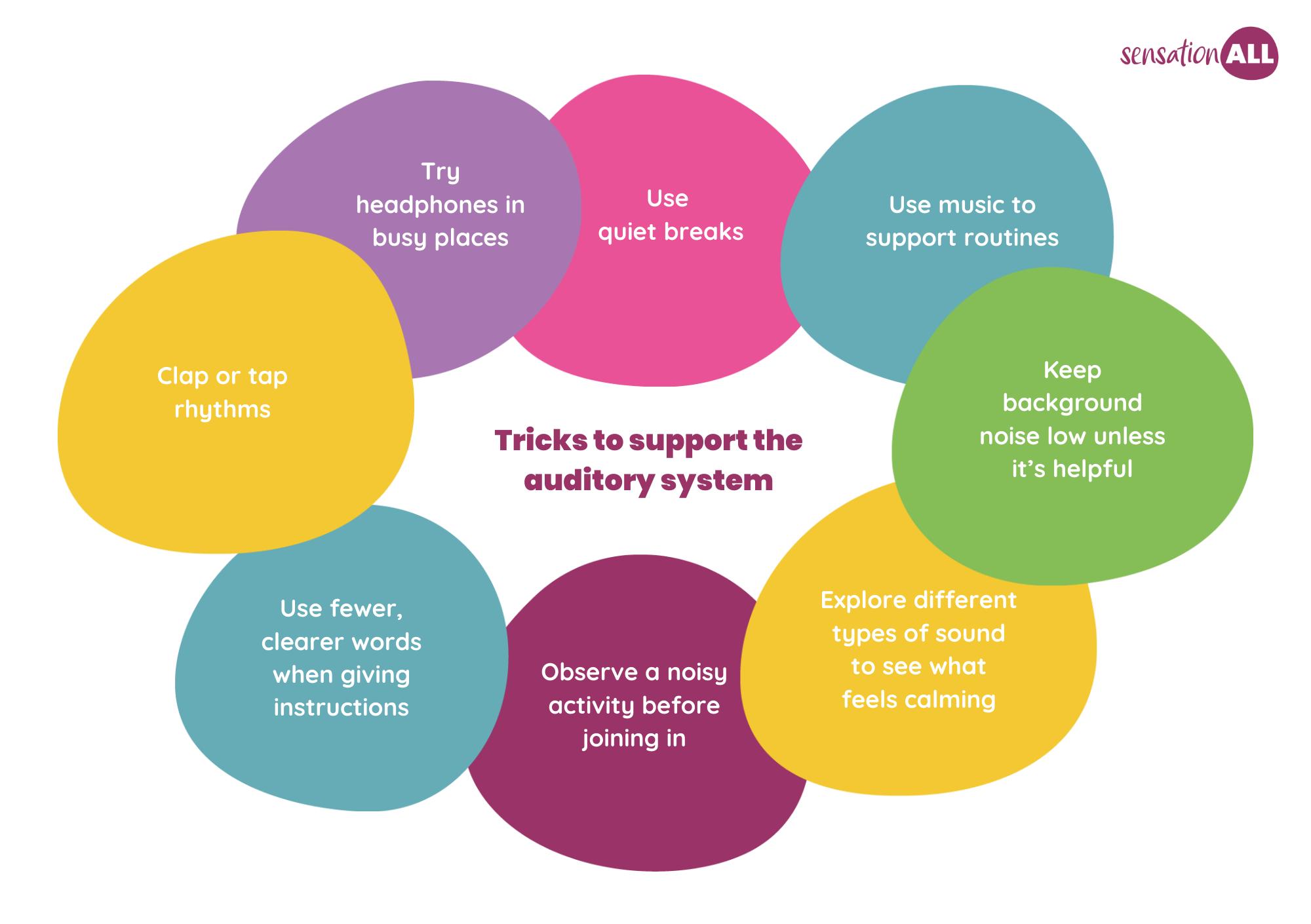
  • Quiet spaces / sensory tents or dens
  • Sensory bins (soft rice, sand, water play)
  • Journaling or drawing feelings
  • Slow, rhythmic rocking or swinging

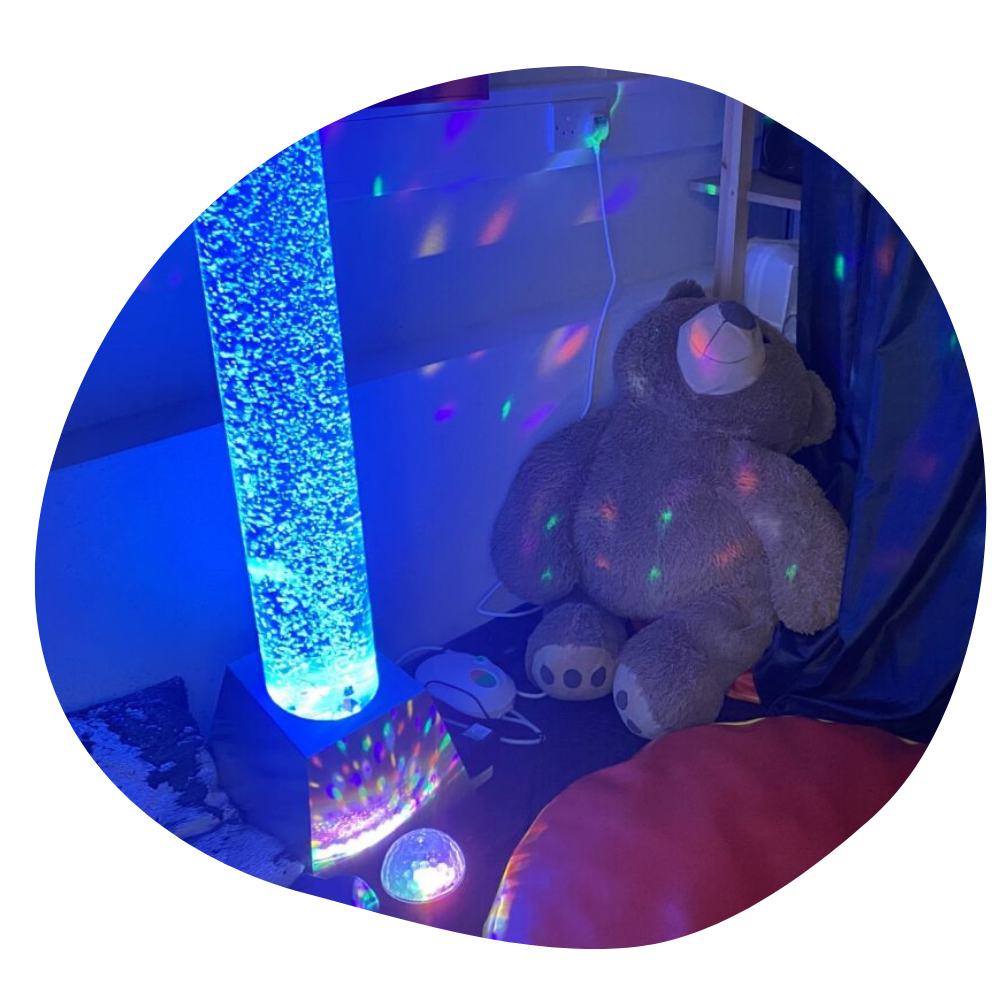
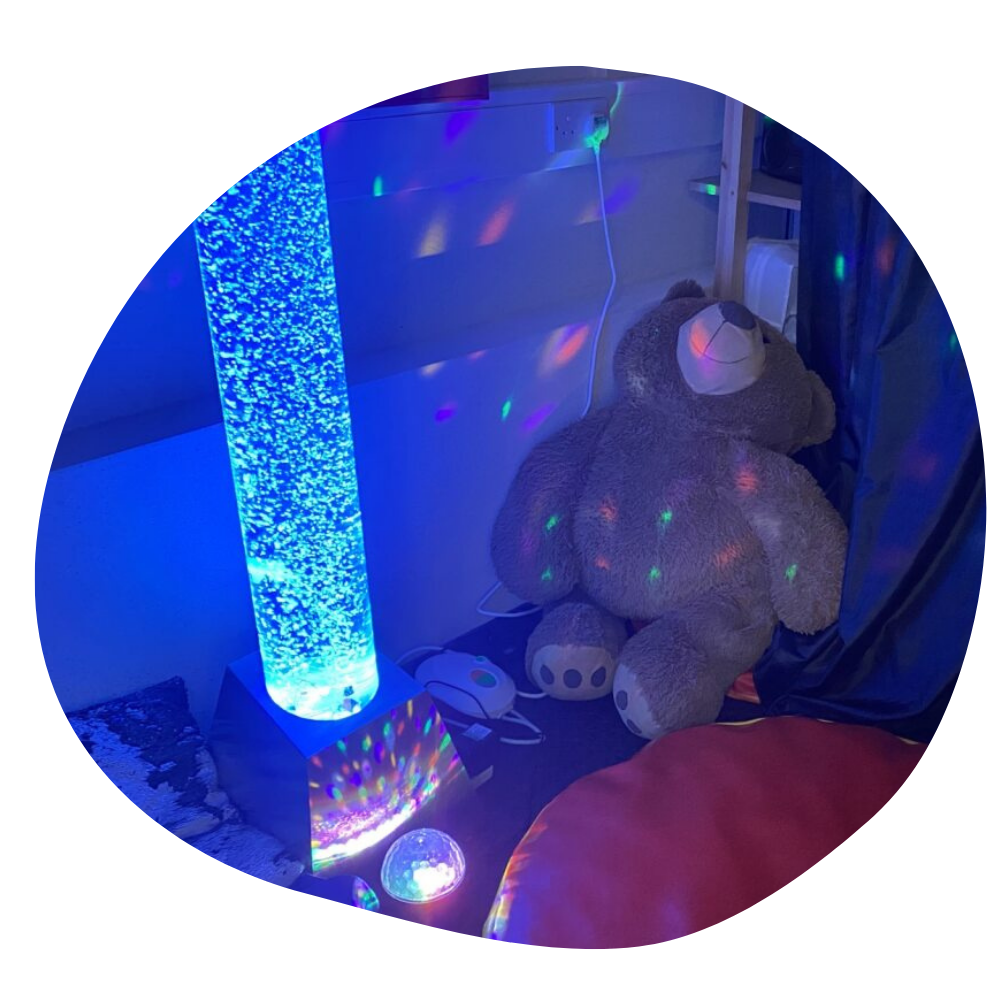
At SensationALL, our sensory rooms provide the ultimate space for peacefulness, with the use of colourful projectors, ambient music and comfortable surroundings. These safe spaces can also be recreated at home with any items that bring you comfort and help you relax, like fuzzy blankets and cushions.

There you have it! It can be trial and error to find what works for your child, but the summer months provide a great opportunity to experiment with different techniques. If you find something that works, why not make it a regular part of your routine!

Follow us on our social media pages for more top tips and information about upcoming events!

Filling the gap in statutory services

As a third sector organisation, SensationALL was founded to make a real difference to hundreds of families and individuals across the northeast living with neurodivergent conditions or additional needs who need practical support and access to social opportunities that are suited to their sensory and behavioural needs. However, this year more than ever we are struggling to keep up with the mounting costs of continuing services in light of the challenging funding climate.  

Amidst the cost-of-living crisis, we are facing both a rise in operational costs and a fall in funding. This is at a time when lengthy waits for NHS assessments are resulting in increasing numbers of families being referred to us for pre-diagnostic support, adding to the strain on our services.  

In the last year, we delivered over 600 sessions which provided more than 520 different people with specially designed social groups and activities to suit their sensory and behavioural needs. However, demand is increasing faster than funding, and we urgently need to generate more income to expand the existing timetable.

Currently, we have over 1400 registered individuals with more people contacting us every week as SensationALL’s Chief Executive, Katie McNutt, explains:  

Our charity has been filling a gap in statutory services in the northeast for the last 13 years, stepping in to offer support when statutory organisations are unable to intervene due to no formal diagnosis being in place.

But even people with a diagnosis find there is a severe lack of social activities and support groups for neurodivergent people where they can make friends, build confidence and importantly, be themselves without judgement in places where their additional needs are accommodated.

Furthermore, parents and carers are in desperate need of practical advice so they can feel better equipped to support their loved-one to overcome challenges their conditions present in everyday life (from sleep to restricted diets to sensory processing issues and accessing education). 

In June, a shocking report was published by The Scottish Parliament; “Neurodevelopmental Pathways and Waiting Times in Scotland”, which outlines a concerning picture of neurodivergent care in Scotland: 

  • Over 42,000 children in Scotland are waiting for a neurodevelopmental assessment, and in some regions this figure has increased by over 500% since 2020. (Statistics as of March 2025) 
  • Increased awareness of neurodivergence in adults has also led to a surge in demand for adult assessments, and over 23,000 adults are waiting for a neurodevelopmental assessment in Scotland which has increased by over 2200% since 2020. 
  • The average longest waiting time to receive an assessment is 182 weeks (three and a half years).
  • Increased demand for support has led to increased pressure on the third sector, which provides a range of pre and post diagnostic support for neurodivergent people in Scotland. 

These statistics prompted a response from The Royal College of Psychiatrists in Scotland and the Child Heads of Psychology Services, who have created a proposal of a “new four-level neurodiversity pathway structure” which calls for a national approach to be taken to commissioning specialist third sector organisations providing support and services at all stages of the diagnostic journey”.

Specific examples of the support given by in the response include “establishing and maintaining peer support networks, and employability training” which mirrors much of what we are already doing without consistent funding.  

Katie explains how the charity would welcome this approach which would bring more much-needed sustainable funding:

A key part of our growth strategy is the ambitious and exciting redevelopment of The Old Schoolhouse, our headquarters in Westhill. We are eagerly awaiting the decision of a planning application to Aberdeenshire Council for the building extension, which will double the current footprint but will cost around £1 million in construction costs which we will have to fundraise for over the next couple of years.

The upgraded facility is desperately needed and will greatly enhance local services available to hundreds of families across the northeast – we are eager to engage with stakeholders who can support the project. 

The Old Schoolhouse

If you are interested in supporting SensationALL, please donate to our cause below, or if you have any other queries get in touch at info@sensationall.org.uk.

Therapy-based play

One thing we know how to do at SensationALL is how to make our sessions fun!

Our creative team use a wide range of games to get youngsters moving their bodies and trying different sensory experiences. Play allows practitioners to implement clinical practices that are vital to improve self-regulation so youngsters are building skills without even realising it! 

We asked practitioners, Michael and Rebekah to tell us how they have been using the classic game ‘Marco Polo’ in their sessions recently…

Many neurodivergent people have difficulty with impulse control meaning they often respond to urges, thoughts or situations in extreme ways. We work with individuals to improve their self-awareness so they can feel in control whenever they are triggered by sensory stimulus or busy environments.

As Rebekah explains, “we play Marco Polo as it is perfect to strengthen the nervous system while building youngster’s tolerance of stressful situations“. The game’s format of start/stop actions supports inhibitory control (our ability to think before reacting) giving youngsters chance to practice managing their impulses. 

There is a ‘rush’ element at the start of the game when the players must race to find a hiding spot, so they need to move quickly and make a decision. Once in their hiding place, they must stop, stay still and be quiet, forcing them to fight the urge to move and make noise.  

During play, the game’s rules encourage them to focus their attention, behaviour, thoughts, and emotions by pausing and then using their reasoning to shout ‘polo’ at the right time. 

The game allows players to experience how the fight, flight and freeze responses feel in their body through positive, fun activities.

As the catcher gets closer to those hiding, they will experience heightened emotions before returning the nervous system to a state of calm. Going through this sequence of feelings repeatedly demonstrates that they are safe in their body and helps them learn to manage and respond appropriately and safely.

By introducing these experiences via a fun game, we reduce negative reactivity which may be dangerous or harmful. Over time youngsters will build their tolerance (slowly!) to stress.  

Plus, all games allow children to practice turn taking and social interaction – so there are lots of benefits!


There are lots of games that can be played at home with the same effect:

  • Hide & Seek
  • Stuck in the Mud
  • Floor is Lava
  • Simon Says
  • Freeze Tag
  • Musical Statues

Why not choose a game for you and your family to do at home – you could make it a regular feature in the week.

Follow us for more tips and suggestions! Join the newsletter mailing list here

Getting through the festive season

Most people look forward to the festive period but if you are neurodivergent then it can exacerbate issues you already find tricky… changes in routine, activities and expectations.

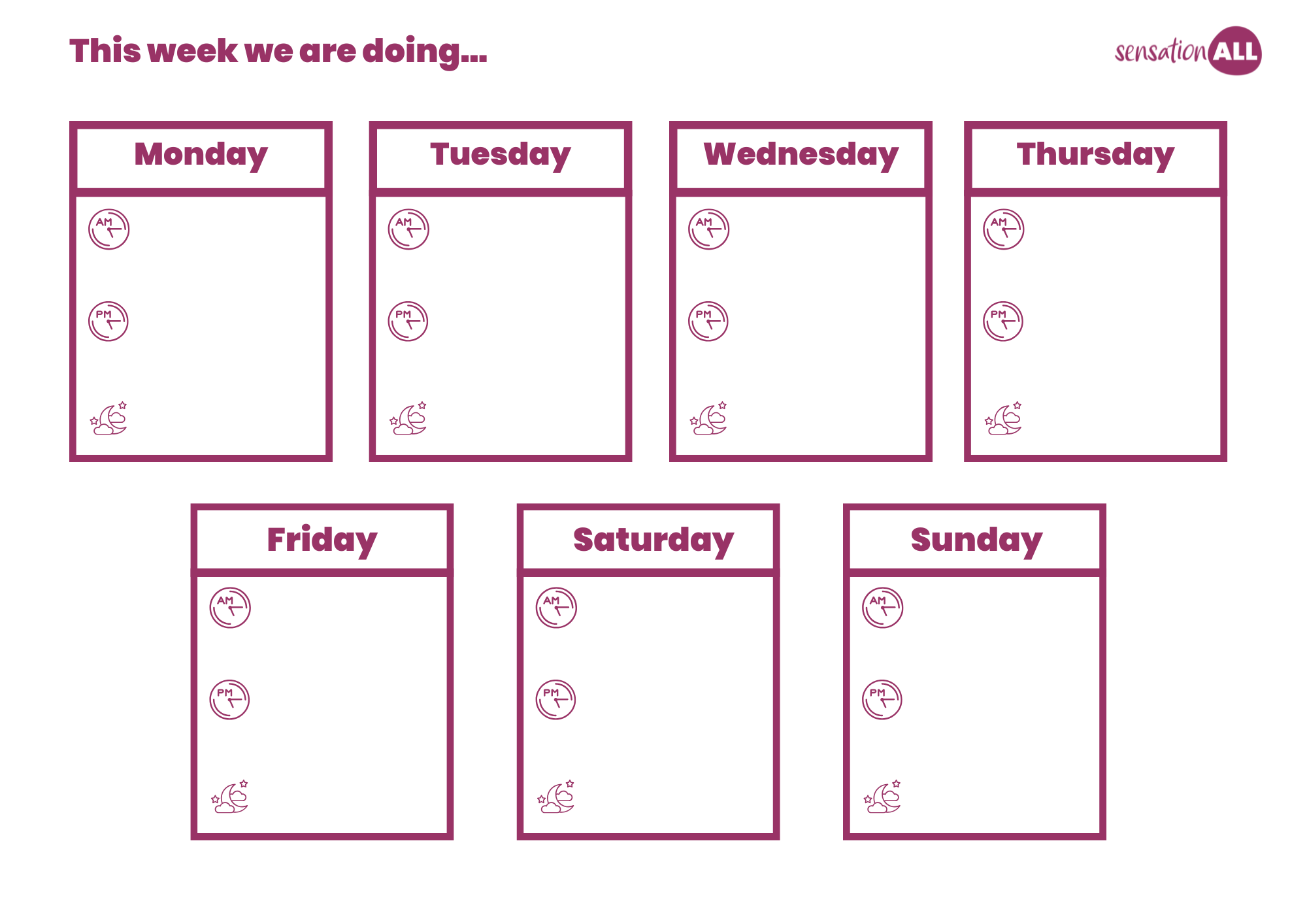
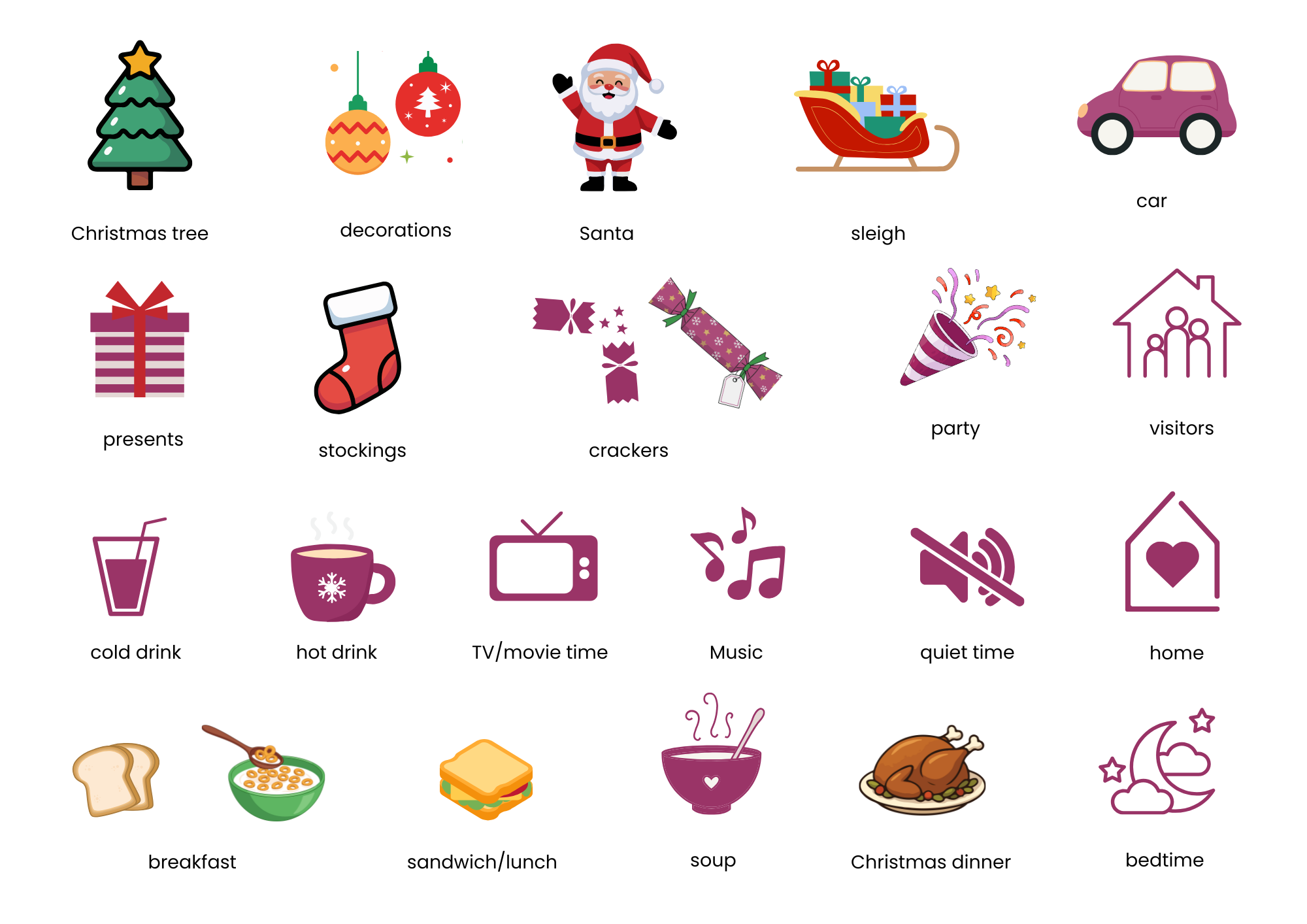
Some of our ‘neuro-spicy’ staff and families have collaborated to pull together this list of tips and suggestions to help you tackle the Christmas and New Year period. We’ve even included some handy templates and resources!  

It’s ok to do your version of whatever you want, or need, to do!

Be by yourself, have no decorations, eat your usual favourite foods, stay in jammies, play with old familiar toys, watch the same old TV programmes, open presents (do they need wrapped?) when you feel like it… whatever helps you and your family to cope with these different festive experiences.

Reducing demands can help avoid overwhelm and meltdowns, so everyone can self-regulate.

Social demands can be high at this time of year, so try to be aware of your own social battery and be selective about what you commit too; even if this means missing a gathering or leaving early. Space out social events to make sure you and your family have time to recover and decompress. 

Reducing sensory overload can be tricky at this time of year. Here are some ways to cope:

  1. Create a safe/quiet space with sensory supports and familiar comfy clothes/blankets or ear defenders if needed.
  2. Consider your environment. How can you reduce food smells, lighting or noise? Does changing the environment help; take time out in a quiet, safe space, go outside/for a drive.

  3. Use familiar sensory tools and resources. If you are going out remember to take your favourite sensory items with you. Being in busy or unfamiliar social settings could result in an increase in stimming behaviour and greater reliance on sensory tools.
  4. Communicate. Explain to people if you or your loved one is feeling overwhelmed. Why not encourage the whole family to use our energy battery to share how they are feeling – you can even turn it into a game! If the adults/non-neurodivergent people model some regulating activities (massage, deep breathing, bear hugs, active calming etc.) then it becomes the norm. Brief the whole family on what the triggers or signs of dysregulation are for you and tell them what your sensory solutions and strategies are. 
  5. Plan sensory breaks or active moments try to avoid sensory overwhelm by proactively taking time out to regulate and recharge.

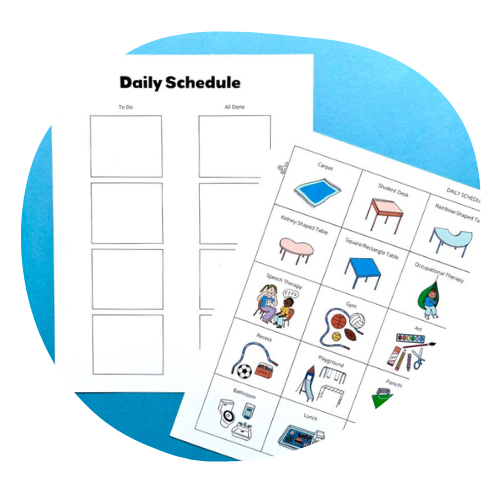
Preparing for all the changes to routine and expectations is so important! If you introduce visual supports such as calendar countdowns, social stories, schedules in advance then you/your neurodivergent loved-one will feel more in control. Having a set routine of activities can help many, others might prefer having a choice of what activities they do or what order they do them in. Use visual choice boards so they can choose and during activities, timers can be great to define the start and end.

There can be a lot of anxiety and/or excitement associated with Christmas, especially Christmas eve when sleeping may be even more difficult. Prioritise some relaxation exercises and wind-down time before bedtime to try ease the transition to sleep (remember, relaxation for some can be both low and high energy!).

Trying to juggle everyone’s needs and expectations at this time of year can be very stressful. It is almost impossible to achieve this. It can be particularly tricky having some children or adults in the household who can and want a more traditional Christmas, balancing that with those who find it more difficult and require their own version. Remember to use your usual strategies and techniques – if that means using separate rooms, each doing different activities at different times, using screen time, fidgets/sensory supports, limiting time at the table, eating under the table, particularly at unfamiliar environments or in a group situation, that is ok.

Maybe having a code word, gesture or symbol card to demonstrate a need for support between family members could work. Remember your own needs – take the time and space to calm your chaos: step outside into the cold air, take some deep breaths, listen to your favourite music! 

Christmas expectations template

Fill this template in and share with others to help them understand your needs.

We know it can be hard to initiate conversations with family or friends about why you and your loved-ones do things differently at Christmas so hopefully this will make it a little easier.

By explaining your requirements you can set expectations which will help them understand and accommodate your needs so everyone has a good time!

Colouring sheets

Regulation tools

Socialising when you are neurodivergent

Some may think that is an overly generalised statement but, the reality is that modern life is fast paced, highly stimulating and demanding, which is incredibly difficult for everyone but especially for those with additional support needs. Life today comes with a never-ending list of societal expectations, pass your exams, go to University, build a fulfilling career, have successful relationships, become a parent, contribute to your community (we could go on!😉). If you have a neurodivergent condition such as Autism or ADHD, then living up to these expectations can be an up-hill struggle.

The numerous unwritten rules of how to engage in social settings are a minefield for neurodivergent people and they can find building friendships or personal interactions particularly challenging!

For example, a neurodivergent person may struggle to interpret conversational cues so doesn’t understand or see the point of ‘small talk’. Or someone who finds reading body language tricky so is oblivious to another person trying to instigate a conversation and comes across as rude or abrupt when they give one-word answers (or walk away while the other person is mid-sentence!).

And nowadays these situations occur during online interactions too! The expectation that everyone will have a social media presence to document their every move and thought is an additional pressure. Communicating via the internet might be less intimidating than face-to-face interactions for many neurodivergent people but, they are still expected to do this within the ever-changing parameters of digital etiquette which can be difficult to monitor.

All of this leaves many neurodivergent people isolated and excluded because society is not flexible enough to accommodate anyone who processes information and situations differently. They are forced to work extra hard to process the world around them, often ‘masking’ their neurodiversity, by hiding their stimming behaviour or forcing themselves to maintain eye contact or sit still just to fit in. But that requires a massive amount of energy and many people reach ‘burnout’ as they become mentally, psychologically and emotionally exhausted.

Well in an ideal world, society would change but sadly, it’s not that straight forward. Awareness of neurodiversity is increasing but, practical steps to accommodate neurodivergent people are slow at being implemented throughout society.

  • More social spaces!

There needs to be a greater understanding and acceptance of neurodivergent people who should be celebrated and included rather than being expected to adjust their behaviour to conform to restrictive societal expectations. There is a shortage of social activities where neurodivergent people can meet others and socialise without sensory overload and where neuro-inclusivity is the norm, not the expectation!

At SensationALL, our mission is to provide safe places for ALL ages to access play and social groups where everyone can be themselves and feel they belong with support from our specialist practitioners.

Our range of social groups, known as ‘SociALLise’, are designed around the preferences and needs of the attendees so they can have fun doing things they enjoy. There are SociALLise groups for primary school ages, teenagers and young adults and we now regularly hold five different sessions each week in Aberdeen and Westhill.

Most importantly, SociALLise is a community! Once you have a place, it is yours for life. Over the years, many youngsters have transitioned from the primary school aged groups right up to the young adult groups and along the way have made life-long friends.

a SociALLise attendee

  • Practical Support

We believe in empowering individuals by sharing our SensationALL tips and techniques which they can use in everyday life to feel more resilient in overwhelming situations. Sessions are a safe space to share experiences and open up about worries allowing them to understand more about themselves and build self-value and feel accepted. This support allows them to take ownership of their neurodivergent identity as they realise they are not alone.

Our team of practitioners have a wealth of experience in supporting individuals with complex needs and as some identify as neurodivergent themselves they can use first-hand experiences to relate to our attendees.

Demand is growing exponentially for places in our SociALLise sessions and we have 90 youngsters waiting for places right now! New families are approaching us every week but we need to increase our income before we can create more of these invaluable groups.

Our aim is to have more SociALLise sessions taking place in locations across Aberdeen and Aberdeenshire so if you want to help SensationALL support more young neurodivergent people please get in touch! You could fundraise for us or get involved with one of our upcoming events, click below for details.

For anyone interested in using our services or attending a SociALLise session, the first step is to register with us.