
Meet the admin team

Elaine and Ellie are our fabulous Service Coordinators who keep all the administrative functions of the charity running smoothly! They are the people who answer your email enquiries, book you onto sessions and take care of lots of other things including IT, health & safety and everything else to keep our buildings running smoothly!

What’s your role at SensationALL and what does it involve?
I am one of the Service Coordinators, concentrating on training (parents/professionals/employers), Learning Pathways Plus (LPP) sessions for individual neurodivergent schoolchildren, and organising the ‘Tea & Tips’ sessions (1-2-1 chats with a practitioner for parents). I also carry out some of the H&S tasks such as weekly fire alarm testing, fire extinguisher checks, the stocking of First Aid kits, plus building, garden, car park and play park inspections.

What do you like most about SensationALL / what does SensationALL mean to you?
I am in awe of our Service Team – their knowledge and compassion is amazing and when you see them working with our attendees, I just think they are awesome. I work in the Administration office and everyone in there is so kind and helpful, with a great sense of humour.  It’s a pleasure to go into work each day and I am immensely proud of the work that we all do.

How long have you been at SensationALL?
I’ve been here for just over 3 years now.

What’s your favourite sensory activity?
I love the vibration plate!  If I have a couple of minutes whilst boiling the kettle, you’ll probably find me on the machine getting a good shake down!  I also love standing on a Bosu balance ball – it feels like I’m doing some exercise.

A fun fact about yourself!
I am also a Wedding Ceremony Officer, as well as a Match Day First Aider at Pittodrie.  In my spare time, I volunteer with the Scottish Charity Air Ambulance and as a Community Cardiac Responder in Westhill.

What’s your role at SensationALL and what does it involve?
My role consists of being the primary point of contact for our families and finding support and sessions that are beneficial for them. (and a whole bunch of background IT stuff!)

What do you like most about SensationALL / what does SensationALL mean to you?
My favourite thing about SensationALL is seeing how much it helps our service users and their families. It’s the only place I’ve ever worked where it feels like I really make a difference.

How long have you been at SensationALL?
Almost three years! I started back in May 2023 with way less grey hair!

What’s your favourite sensory activity?
Baking! Especially anything involving chocolate but it has to be vegan.

A fun fact about yourself
I recently got into running and my first ever competitive race was Edinburgh marathon last year! I then did Tough Mudder two weeks after and 4 other races before the end of 2025. 
Celebrating Neurodiversity: How SensationALL supports our community 

At SensationALL, we provide support for people of ALL ages and conditions and their family members removing the barriers of a formal diagnosis. Currently, we interact directly with over 480 individuals each year across 800+ sessions, but the demand we face is much greater. With over 1,900 registered service users and close to 200 named on our waiting lists actively seeking a space in one or more of our services, it’s clear that we need to do more. 

As a charity who receive no statutory funding, we rely entirely on grants, donations, corporate partnerships, and fundraising efforts to keep our services running. Like many charities, we are navigating an increasingly competitive funding landscape, with reduced funding available and rising demand leading to higher rejection rates. 

Our groups are different to mainstream or public recreational activities because we create a safe, welcoming environment where our specially trained staff support attendees so they can: 

  • Recharge and express themselves freely 
  • Build genuine friendships 
  • Reduce loneliness and isolation, reducing mental health risks 
  • Connect with a community of people who accept them as they are 

We carefully match each person to a group that suits their needs. Sessions are designed to help people with sensory processing or emotional issues to build skills that will improve confidence, social interaction and resilience. 

To ensure everyone can thrive we: 

  • Keep group sizes small (an average of 6-8 per session) 
  • Considers the person needs of attendees not just age so we can meet their behavioural and sensory needs  
  • Operate waiting lists to accurately gauge demand for each service and support level 

Sadly, despite our best efforts to grow services, waiting lists are increasing faster than ever before and many are left waiting for support they can’t access anywhere else. 

At SensationALL, we believe everyone deserves equal access to meaningful social opportunities. For many, our groups are their only opportunity to make friends and feel a sense of belonging. 

We also support parents and carers, helping them feel informed, confident, and connected. Our families report: 

  • Improved mental health and wellbeing 
  • Stronger family dynamics 
  • Loved ones developing better self-regulation and social skills 

Our approach creates a supportive environment for the whole family, enabling individuals to thrive at every stage of life. 

We are working hard to expand our timetable and create more spaces, but we need your help. The funding climate is tough for all charities, so donations, corporate partnerships, and fundraising support means more than ever!  

Every pound you contribute will enable us to reach more people and provide the vital services our community relies on. 

You can make a difference: 

  • Fundraise for SensationALL – there are so many opportunities coming up, why not do the Kiltwalk for us in 2026?! 
  • Dontate to SensationALL or support our fundraising campaigns 

Together, we can ensure that every neurodivergent individual and their family in the north east has the support they deserve to thrive. 

Meet the service team!

Collectively our team of practitioners and support workers have decades of experience working with people with complex needs and a wealth of knowledge and expertise.

about Chloe

What’s your role at SensationALL and what does it involve?
My role as Service Team Lead bridges service demand, design, and delivery with operations and HR. I collaborate with the operations team, session coordinators, and Clinical Team Lead to schedule and deliver services, recruit and allocate staff, lead our team of practitioners and youth workers, manage appraisals and training needs, as well as have fun in some sessions too!

What do you like most about SensationALL?
The shared passion within the team for supporting neurodivergent individuals, their families, carers, and the wider community. The genuine, authentic care shown by the team drives our work and ensures that a needs-led, person-centred approach remains at the heart of everything we do. I feel proud to work for a charity that retains such a strong sense of purpose and fosters an environment built on inclusion, understanding, and lived experience.

How long have you been at SensationALL?
I have been at SensationALL for over 3 years now, starting in a Youth Worker position in 2022, and becoming Service Team Lead in 2023. 

What’s your favourite sensory activity?
My favourite sensory activities are movement-based. I especially enjoy using the balance boards and vibration plates, as well as active games in the soft play room, particularly hide and seek or grounders. I also love making slime!

about Rebekah

What do you like most about SensationALL / what does SensationALL mean to you?
What I love most about SensationALL is the deep respect for every child and adult as an individual. SensationALL means safety, understanding, and possibility to me. It’s a place where differences are welcomed, nervous systems are honoured, and children are supported to thrive in ways that feel right for them.

How long have you been at SensationALL?
I’ve been part of SensationALL for 8 years.

What’s your favourite sensory activity?
My favourite sensory activity is anything involving deep pressure or heavy work. It’s grounding, regulating, and such a powerful way to help children feel safe and settled in their bodies.

about Fran

about Marie

about Kirsty

about Caitlin

about Hollie

about Jo

In addition to these wonderful people we have an enthusiastic team of support & youth workers who assist the practitioners during sessions.

Getting through the festive season

Most people look forward to the festive period but if you are neurodivergent then it can exacerbate issues you already find tricky… changes in routine, activities and expectations.

Some of our ‘neuro-spicy’ staff and families have collaborated to pull together this list of tips and suggestions to help you tackle the Christmas and New Year period. We’ve even included some handy templates and resources!  

It’s ok to do your version of whatever you want, or need, to do!

Be by yourself, have no decorations, eat your usual favourite foods, stay in jammies, play with old familiar toys, watch the same old TV programmes, open presents (do they need wrapped?) when you feel like it… whatever helps you and your family to cope with these different festive experiences.

Reducing demands can help avoid overwhelm and meltdowns, so everyone can self-regulate.

Social demands can be high at this time of year, so try to be aware of your own social battery and be selective about what you commit too; even if this means missing a gathering or leaving early. Space out social events to make sure you and your family have time to recover and decompress. 

Reducing sensory overload can be tricky at this time of year. Here are some ways to cope:

  1. Create a safe/quiet space with sensory supports and familiar comfy clothes/blankets or ear defenders if needed.
  2. Consider your environment. How can you reduce food smells, lighting or noise? Does changing the environment help; take time out in a quiet, safe space, go outside/for a drive.
  3. Use familiar sensory tools and resources. If you are going out remember to take your favourite sensory items with you. Being in busy or unfamiliar social settings could result in an increase in stimming behaviour and greater reliance on sensory tools.
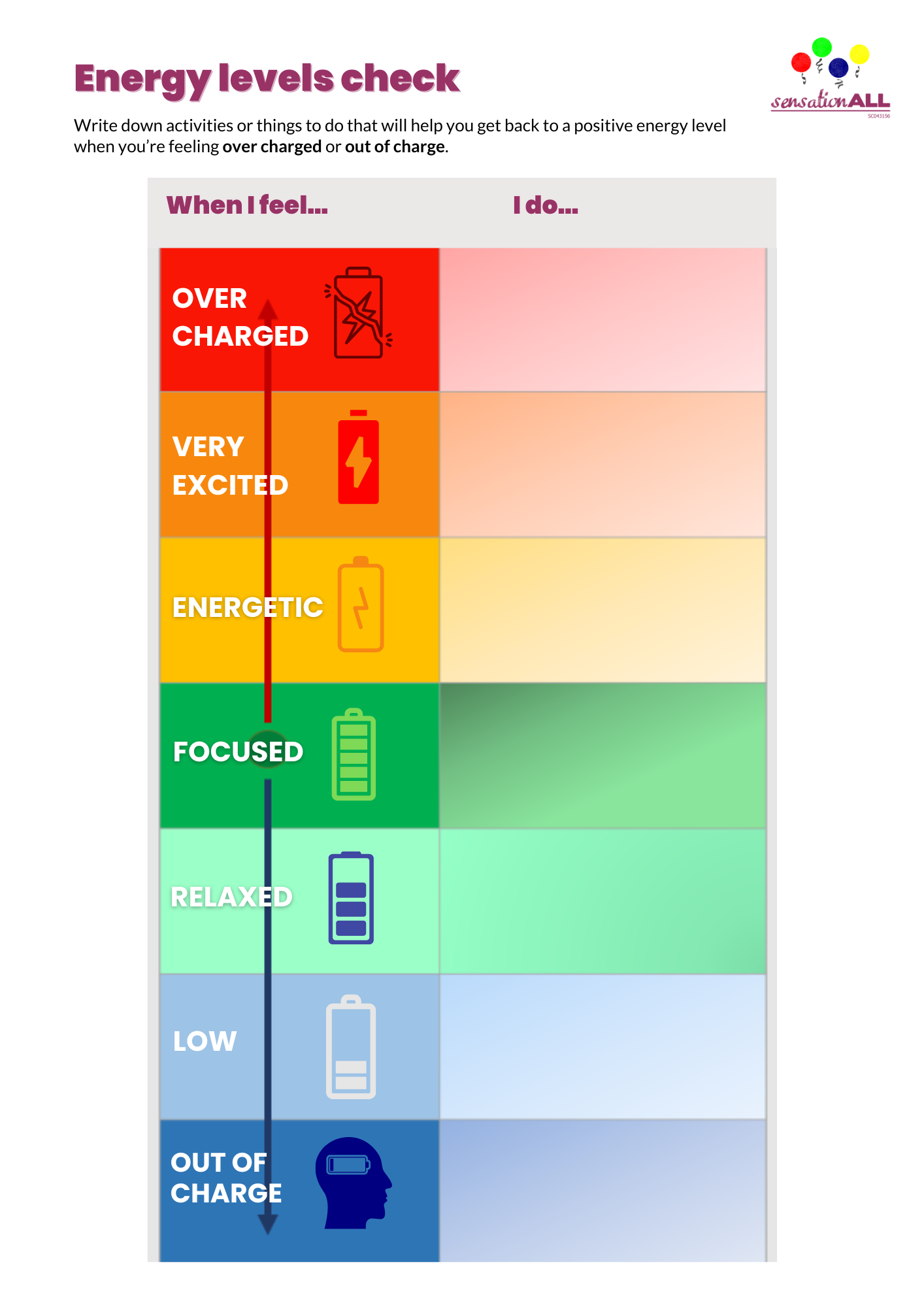
  4. Communicate. Explain to people if you or your loved one is feeling overwhelmed. Why not encourage the whole family to use our energy battery to share how they are feeling – you can even turn it into a game! If the adults/non-neurodivergent people model some regulating activities (massage, deep breathing, bear hugs, active calming etc.) then it becomes the norm. Brief the whole family on what the triggers or signs of dysregulation are for you and tell them what your sensory solutions and strategies are. 
  5. Plan sensory breaks or active moments try to avoid sensory overwhelm by proactively taking time out to regulate and recharge.


Preparing for all the changes to routine and expectations is so important! If you introduce visual supports such as calendar countdowns, social stories, schedules in advance then you/your neurodivergent loved-one will feel more in control. Having a set routine of activities can help many, others might prefer having a choice of what activities they do or what order they do them in. Use visual choice boards so they can choose and during activities, timers can be great to define the start and end.

There can be a lot of anxiety and/or excitement associated with Christmas, especially Christmas eve when sleeping may be even more difficult. Prioritise some relaxation exercises and wind-down time before bedtime to try ease the transition to sleep (remember, relaxation for some can be both low and high energy!).

Trying to juggle everyone’s needs and expectations at this time of year can be very stressful. It is almost impossible to achieve this. It can be particularly tricky having some children or adults in the household who can and want a more traditional Christmas, balancing that with those who find it more difficult and require their own version. Remember to use your usual strategies and techniques – if that means using separate rooms, each doing different activities at different times, using screen time, fidgets/sensory supports, limiting time at the table, eating under the table, particularly at unfamiliar environments or in a group situation, that is ok.

Maybe having a code word, gesture or symbol card to demonstrate a need for support between family members could work. Remember your own needs – take the time and space to calm your chaos: step outside into the cold air, take some deep breaths, listen to your favourite music! 

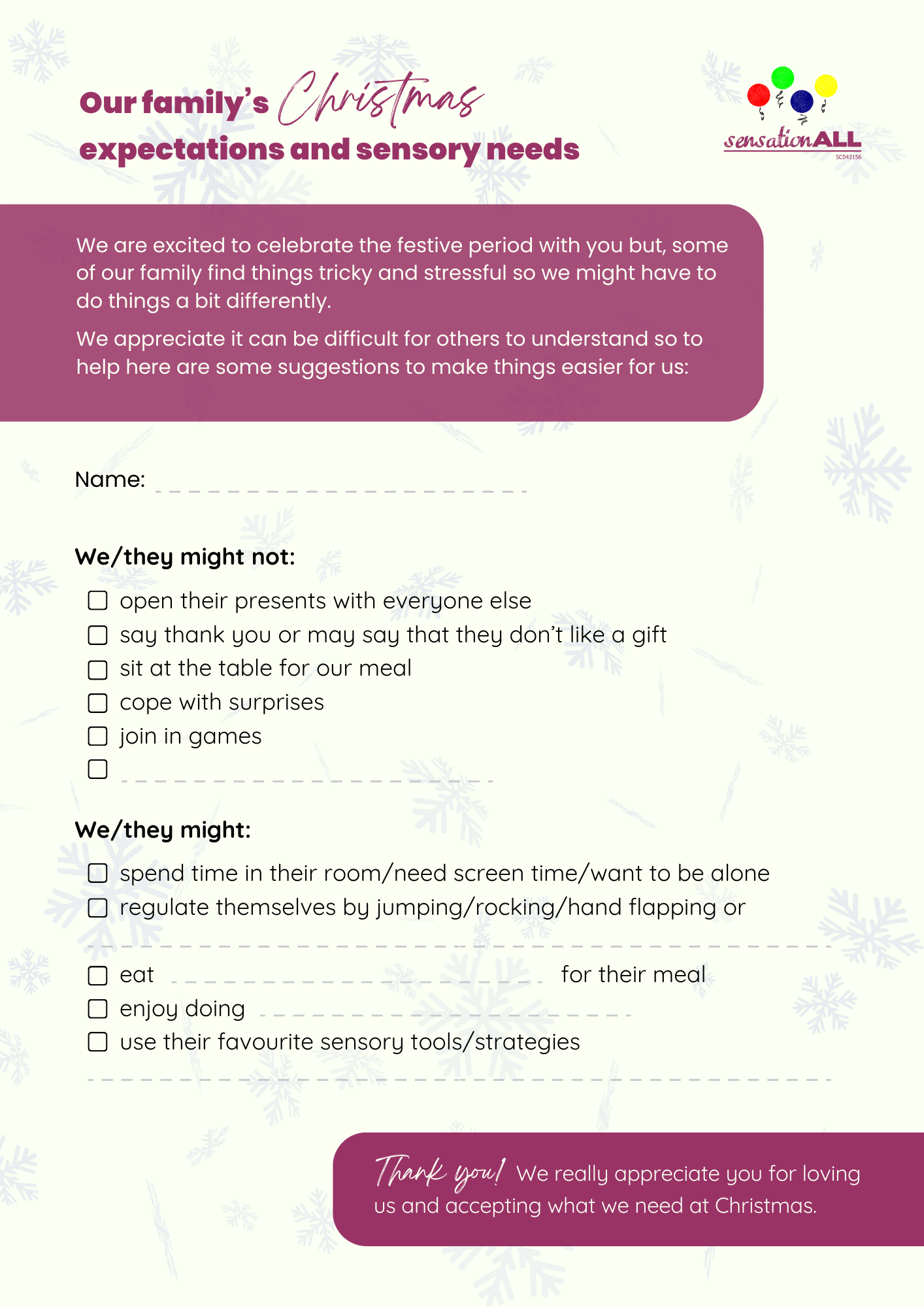
Christmas expectations template

Fill this template in and share with others to help them understand your needs.

We know it can be hard to initiate conversations with family or friends about why you and your loved-ones do things differently at Christmas so hopefully this will make it a little easier.

By explaining your requirements you can set expectations which will help them understand and accommodate your needs so everyone has a good time!

Colouring sheets

Regulation tools

Socialising when you are neurodivergent

Some may think that is an overly generalised statement but, the reality is that modern life is fast paced, highly stimulating and demanding, which is incredibly difficult for everyone but especially for those with additional support needs. Life today comes with a never-ending list of societal expectations, pass your exams, go to University, build a fulfilling career, have successful relationships, become a parent, contribute to your community (we could go on!😉). If you have a neurodivergent condition such as Autism or ADHD, then living up to these expectations can be an up-hill struggle.

The numerous unwritten rules of how to engage in social settings are a minefield for neurodivergent people and they can find building friendships or personal interactions particularly challenging!

For example, a neurodivergent person may struggle to interpret conversational cues so doesn’t understand or see the point of ‘small talk’. Or someone who finds reading body language tricky so is oblivious to another person trying to instigate a conversation and comes across as rude or abrupt when they give one-word answers (or walk away while the other person is mid-sentence!).

And nowadays these situations occur during online interactions too! The expectation that everyone will have a social media presence to document their every move and thought is an additional pressure. Communicating via the internet might be less intimidating than face-to-face interactions for many neurodivergent people but, they are still expected to do this within the ever-changing parameters of digital etiquette which can be difficult to monitor.

All of this leaves many neurodivergent people isolated and excluded because society is not flexible enough to accommodate anyone who processes information and situations differently. They are forced to work extra hard to process the world around them, often ‘masking’ their neurodiversity, by hiding their stimming behaviour or forcing themselves to maintain eye contact or sit still just to fit in. But that requires a massive amount of energy and many people reach ‘burnout’ as they become mentally, psychologically and emotionally exhausted.

Well in an ideal world, society would change but sadly, it’s not that straight forward. Awareness of neurodiversity is increasing but, practical steps to accommodate neurodivergent people are slow at being implemented throughout society.

  • More social spaces!

There needs to be a greater understanding and acceptance of neurodivergent people who should be celebrated and included rather than being expected to adjust their behaviour to conform to restrictive societal expectations. There is a shortage of social activities where neurodivergent people can meet others and socialise without sensory overload and where neuro-inclusivity is the norm, not the expectation!

At SensationALL, our mission is to provide safe places for ALL ages to access play and social groups where everyone can be themselves and feel they belong with support from our specialist practitioners.

Our range of social groups, known as ‘SociALLise’, are designed around the preferences and needs of the attendees so they can have fun doing things they enjoy. There are SociALLise groups for primary school ages, teenagers and young adults and we now regularly hold five different sessions each week in Aberdeen and Westhill.

Most importantly, SociALLise is a community! Once you have a place, it is yours for life. Over the years, many youngsters have transitioned from the primary school aged groups right up to the young adult groups and along the way have made life-long friends.

a SociALLise attendee

  • Practical Support

We believe in empowering individuals by sharing our SensationALL tips and techniques which they can use in everyday life to feel more resilient in overwhelming situations. Sessions are a safe space to share experiences and open up about worries allowing them to understand more about themselves and build self-value and feel accepted. This support allows them to take ownership of their neurodivergent identity as they realise they are not alone.

Our team of practitioners have a wealth of experience in supporting individuals with complex needs and as some identify as neurodivergent themselves they can use first-hand experiences to relate to our attendees.

Demand is growing exponentially for places in our SociALLise sessions and we have 90 youngsters waiting for places right now! New families are approaching us every week but we need to increase our income before we can create more of these invaluable groups.

Our aim is to have more SociALLise sessions taking place in locations across Aberdeen and Aberdeenshire so if you want to help SensationALL support more young neurodivergent people please get in touch! You could fundraise for us or get involved with one of our upcoming events, click below for details.

For anyone interested in using our services or attending a SociALLise session, the first step is to register with us.

Adult support group

Thanks to funding from Inspiring Scotland, we have launched a new group for adults aged 18 and over, who self-identify as, or are diagnosed with a neurodiverse condition such as Autism or ADHD.

If you are an adult who has been diagnosed later in life, or if you suspect you have a neurodiverse condition, we know it can be stressful learning how to cope with the challenges that neurodiversity can present. Our support groups have been created to bring you together in a safe, friendly place so you can build networks with others in similar situations. You are not alone!!

Sessions are a chance to meet and socialise with other like-minded adults in a relaxed environment, compare your experiences and perspectives of neurodiversity. Our specialist neurodiversity practitioners will chat about a different topics each week and share their practical advice and knowledge.

We will give you:

  • a safe, non-judgemental place to express yourself
  • an introduction to self-regulation techniques
  • signposting to other organisations and networks that may be of benefit
  • wellbeing and resilience strategies
  • social opportunities to build friendships and peer networks
  • resources to reinforce learnings from sessions

Weekly on Tuesdays, 6.30-8pm

At Belgrave House, Belgrave Terrace, Rosemount, Aberdeen, AB25 2NR

NO FORMAL DIAGNOSIS REQUIRED

SensationALL means the world to me.

SensationALL’s services and activities for Neurodiverse individuals and those with complex conditions are a lifeline for many. However, our support is not only for attendees themselves, but also for the wider family. In 2022, we created a timetable of informal support groups for parent/carers. The benefit of having this peer support can be huge!

Many parents tell us how alone and lost they feel so being part of this network helps them cope with the emotional burden of caring for someone with complex needs. The sharing of experiences and empathy they get from the group is invaluable and can result in improved resilience and reduced anxiety.

We thought Mental Health Awareness month was the perfect time to share one of our family’s stories…


Kelly’s daughter Georgia-Rose has a diagnosis of Autism and is currently undergoing assessment for ADHD. Kelly suspected from a very young age that Georgia-Rose might be Autistic:

“She really struggled with her meltdowns which, I originally thought were just bad tantrums but the older she got it became apparent they were so much more! Georgia-Rose is a huge masker – she keeps everything bottled in at school and plays a character to fit into society but, when she gets home the mask comes off and she often explodes. From a young age she has experienced sensory difficulties, certain sounds, textures and smells would trigger her and we didn’t know how to deal with it”.

The family’s first experience of SensationALL was coming to our Santa’s Grotto after a disastrous visit to a public grotto when Georgia-Rose left feeling terrified and sad. Her parents were flooded with guilt for taking her somewhere that caused such upset and were devastated she couldn’t enjoy something magical that most children love.

After seeing our details on Facebook, Kelly brought her girls to our relaxed grotto at The Old Schoolhouse in Westhill which, was designed to offer an simpler, unintimidating situation for Neurodiverse children to cope with. This time, her reaction to Santa was completely different to Kelly’s delight; “the look on Georgia-Roses face was something I will cherish forever! She went straight into the grotto and actually spoke to Santa! It was the most special thing for us as her parents to see her enjoy something that had previously terrified her!”

This positive experience led to Georgia-Rose attending numerous soft play sessions and she completing our self-regulation programme, Chill-OOT. As a result, her confidence and self-esteem has grown massively and she now knows ways to calm herself down when she’s overwhelmed and her parents and the wider family have also learnt techniques to help her when she in these situations. Amazingly, Georgia-Rose is able to tell them how things make her feel in different situations which is a huge positive step and has benefited the whole family.

Kelly says, “before I came to SensationALL I had absolutely no idea how to cope with Georgie’s meltdowns. I had been given advice from professionals and had done endless amounts of reading online but for some reason nothing seemed to work with my daughter and her difficulties. I constantly felt judged as a parent, and didn’t want my daughter to be thought of as a badly behaved kid who wouldn’t listen to her parents or just screams and shouts to get her own way. I felt very alone as a parent and didn’t know where to I could find help from people who just ‘got it’.

I started attending the parent support group every week and it has been the best thing I’ve done for myself in this journey – I had no idea how much I needed it! Being around other parents who face the same day to day difficulties as I do is just priceless! 

I believe its helped me become a better parent to not only Georgia-Rose, but her youngest sister Ellie-Jane too.

SensationALL means the world to me. It’s a place I can go and cry and know that somebody will be there for me with a tissue and a hot cup of tea. The support I receive is irreplaceable, SensationALL is somewhere I can go and won’t be judged.”

Not feeling alone on this crazy journey of parenting a child with additional support needs is the BEST thing ever!

Kelly

Our Family Support Practitioner, Jo, is also a parent of a young Neurodiverse son so she has experienced many of the situations that our families face:

“I know first-hand that being a parent of a child with additional needs can be isolating and lonely. Parents of neurotypical children can try their best to be supportive but, through no fault of their own, they cannot identify with the unique struggles a parent of a child with Additional Support Needs face daily.  

The sharing of experiences allows parents and cares to be heard, and often, for the first time feel accepted and less alone, it is a privilege for me to watch the magic happen in our sessions. 

Usually, our sessions are simply an open forum when, struggling parents can chat, cry and laugh which, releases tension and you see the weight starting to lift as their share their problems. We journey together as a group, grieving the difficult times, proactively looking for practical solutions to ease the struggles. I’m honoured to be part of the SensationALL community for parents.”

WATCH – this video features Kelly as well as some other parents talking about SensationALL…

If you’re a parent, guardian, or carer, more information on support sessions is here or email us to ask for more information.

*NEW* virtual social group

We’ve been delighted with the success of our virtual services since the pandemic forced us to suspend face-to-face activities. But as a needs led service, we are always looking for ways to improve our programme and respond to input from our attendees.

Therefore, we are delighted to announce that following feedback from our youngsters, we’ve added a brand new social group into the diary – Show & Tell

These weekly sessions are currently FREE OF CHARGE – read on for details of what’s involved…

Show & Tell


He is so engaged that I don’t have to ‘babysit’ him during the call.

It has certainly improved his confidence.

Parent feedback, April 2021

During virtual sessions in 2020, it became apparent that our young service users were relishing the chance to share news or tell each other about their hobbies and interests. It became such an important part of video calls that the idea of a stand-alone Show & Tell group was planted!

The SensationALL team then designed a relaxed, weekly session which uses the Show & Tell format as a way to promote communication and listening skills with each participant encouraged to contribute.

Plus, there are fun activities and challenges to enable each child to practice invaluable social skills such as team work, turn-taking and friendship building.


Who is it for?

Show & Tell is aimed at primary school-age children with support needs who struggle with communication, social interaction or making friends.

Contact us if you would like to discuss your child’s individual needs.

I like it because I get to meet other children and I like the games!

Show & Tell attendee, April 2021

Typical session format

The hour long Show & Tell session follow a semi-structured format with a variety of different activities each week to keep regular attendees interested:

News time – each child gets to share something they’ve done since the last session

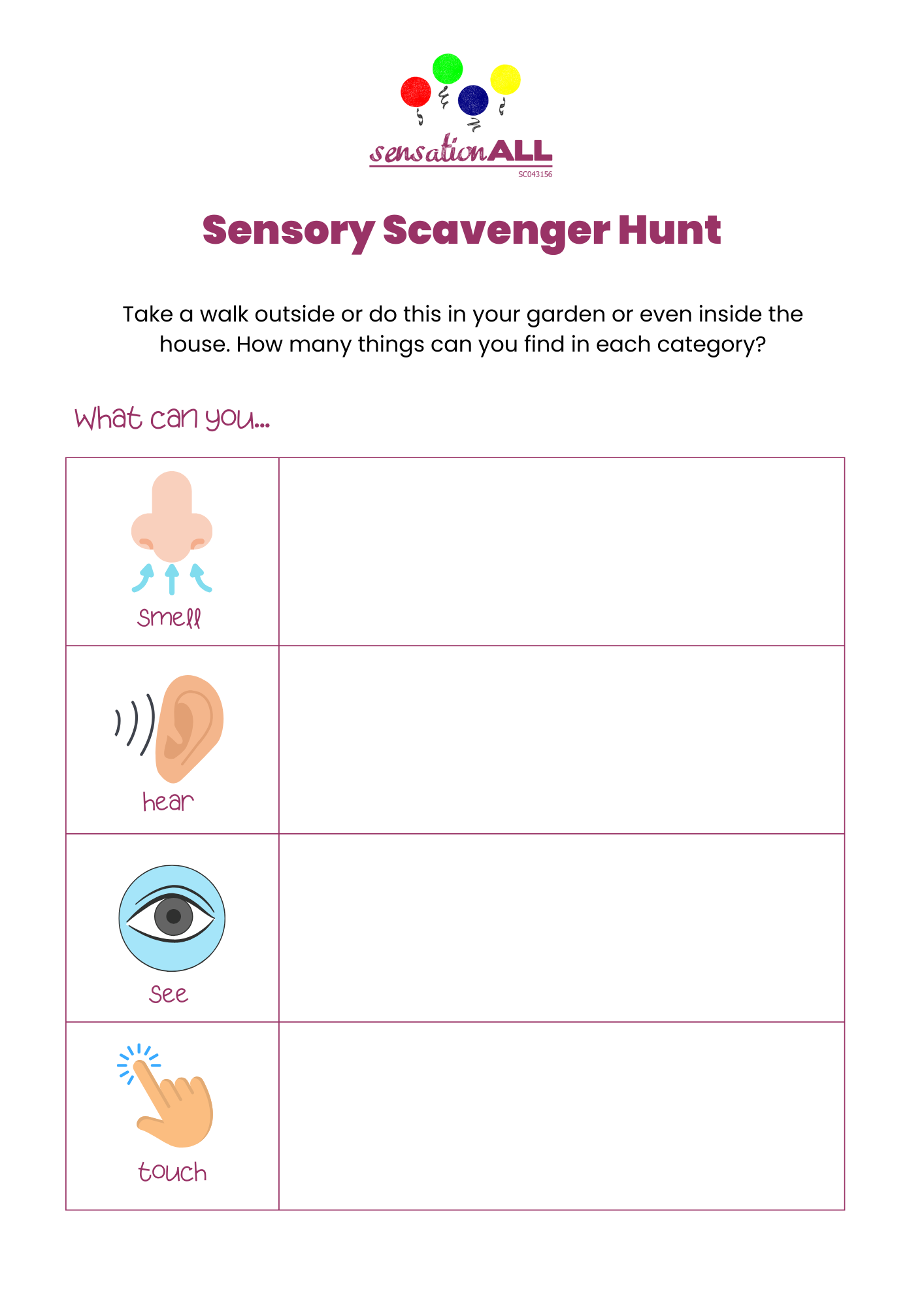
Activities & Games – active time to get them moving (such as scavenger hunts and house tours) or team problem solving games (e.g. quizzes or guessing games with pictures, logos or catchphrases)

Weekly challenge – we set a challenge to complete at home before the next session – they can then share how they got on with it during News Time.

Mindful reflection – we finish each session with a positivity and gratitude discussion when each person shares what they enjoyed most.


Benefits for your child

The aim of each session is to provide a safe space for your child to build their confidence in social groups.

We work on:

– improving tolerance towards others (through turn-taking and listening)

– communication skills

– increasing independence

– building positive friendships & relationships


Watch a recent Show & Tell session


Book a place

Sessions are available term time – MONDAYS – 4.30-5.30pm or 6-7pm

Via secure video call.

Booking is essential as group sizes are capped – email info@sensationall.org.uk

How to have a ‘SensationALL’ lockdown!

The Coronavirus outbreak has affected everyone and SensationALL is no exception!

With our face to face services at the Old Schoolhouse suspended, our dedicated team immediately began investigating alternative options to support our families remotely.

Social distancing and restricted movement have meant extensive changes in routine which is hard for everyone but, it is extra challenging for families living with a support need (such as Autism Spectrum Disorder, Pathological Demand Avoidance, Attention Deficit Disorder, learning disabilities, sensory processing conditions and mental health issues).

That is why, at SensationALL, we are committed to continuing to offer our tailored, practical support to those who need it via digital platforms for as long as lockdown lasts.

SensationALL virtual services

For many of our service users, socialising and processing the world around them can be a constant, daily struggle. For our staff, the prospect of not having direct contact with service users was unthinkable and the team were all motivated to come up with new ways of continuing our much-needed support remotely.

So, with some creative, ‘out-of-the-box’ thinking we devised a range of virtual services which will have a significant positive impact on our families’ lives, resulting in happier, calmer children and adults!

Despite a steep learning curve with video call platforms and IT (we’re clinicians so tech is not our strong point!) we are now in our second month of delivering a range of virtual services, including:

@home sessions

1:1 video calls with a SensationALL team member who provides tailored interaction.

The call can include sensory activities, relaxation, games or just a chat – whatever the individual needs!

virtual SociALLise

Weekly group video calls for our teenagers & young adults so they don’t miss out on keeping in touch with friends and all-important social interaction. The calls are a great way for the youngsters to share experiences and feelings with peers whilst being supported by our team.

So far, sessions have included… show & tell, quizzes on a variety of topics, drawing, zentangle (mindful) doodling, games (Pictionary, Charades etc.) group sing & sign, TikTok routines, origami, photo competitions and there’s more to come… phew!

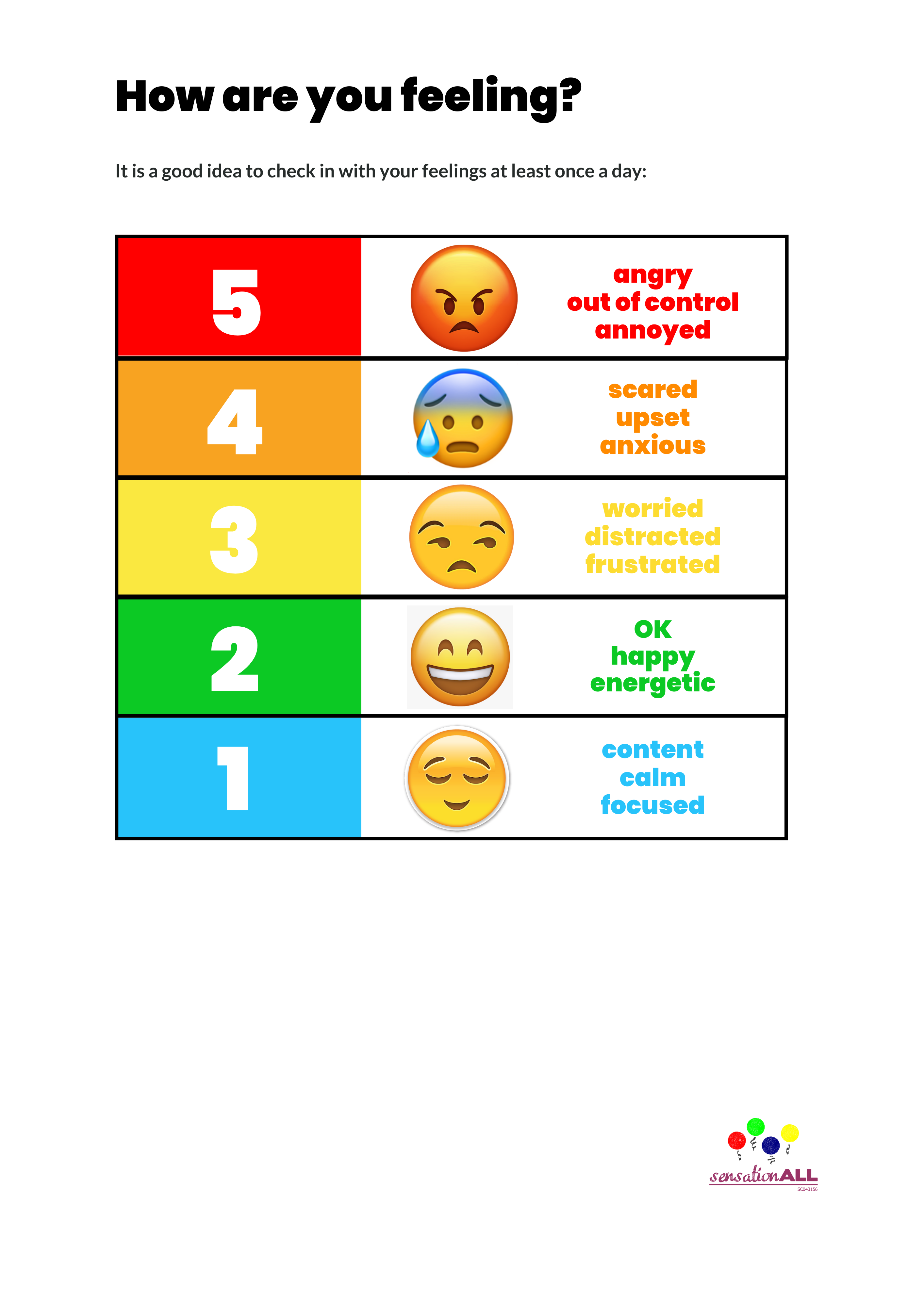
mood meter
Chill-oot!

We’ve adapted our popular self-regulation programme to an online format!

This invaluable programme is for school-aged children with support needs who struggle with emotional regulation or behavioural management. We teach them how to identify, understand and deal with over-whelming emotions and situations. The 4-week online programme starts in May.

Tea and Tips

Our advisory consultations are needed now more than ever!

Parents/carers can have a confidential talk (phone or video call) with one of our senior practitioners about specific challenges they are facing. We will provide practical strategies and techniques to use at home to make lockdown easier.

We are great listeners!

So far, the response has been amazing with 90% of parents rating the virtual support sessions as ‘highly beneficial’ to the individual. Plus, 100% of them reported a benefit or high benefit to their own wellbeing. One parent commented:

 “My son has been unsettled and had a very difficult day the day before. Chatting with a member of the team helped him to remember he is part of a community, that those people are still there, and it reminded him to use his emotions assessment tool. He enjoyed the activities and the breathing exercise helped him settle his mind. Amazing all in a 30 min session!”

In addition to the structured services, we’ve increased the amount of FREE online content available to our followers on social media and those on our mailing list. We are sharing regular video tutorials on Facebook and You Tube so people can follow along at home (Makaton, yoga, make-your-own sensory tools, relaxation exercises and even baking).

Our newly created Resource web page is your reference point for all the best links, resources and guides out there – we’ll save you the time and effort of filtering all the masses of available information!

Plus, our series of @home e-newsletters are packed full of information of how to cope with lockdown when you’re caring for an individual with a support need or disability.

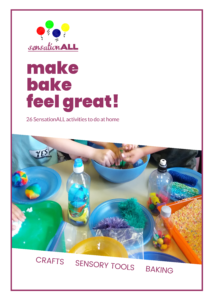
Lastly, (if all that wasn’t enough!) as part of the 2.6 Challenge fundraising campaign we compiled an electronic activity bookMake, Bake, Feel Great! – with 26 activities to do at home.

Copies of this fantastic resource are available in return for a small donation to support us while fundraising events are on hold.

But, we’re not done yet – we have more plans in development… online training courses (to replace of our previously scheduled workshops) and more possible virtual services for the summer.

Obviously, no one is sure how long lockdown or social distancing will last but, for as long as it does we’ll keep adapting our services to meet demand and support you however required.

Get in touch to tell us what you need and look out for future surveys asking for your feedback!

Stay safe, stay SensationALL!

Here for you remotely!

Even though we have taken the difficult decision to suspend our groups and services, our SensationALL team are still here to support you remotely during the ongoing CoronaVirus pandemic.

Tell us what you want to see… we’re open to suggestions and your stories too! We’ll share our tips and resources every week but we’d also love to hear what works for your family so we can share it with the whole SensationALL network.

We’ll get through it by supporting each other!

email info@sensationall.org.uk